TolHouse · Toledo, Ohio
The House
Collection
Thirteen works of contemporary art, hanging in a Members’ House in downtown Toledo. From the collection of Mark Bevington, curated by Paula Baldoni of River House Arts. The hang rotates with the seasons.
A House can hold a bar, a kitchen and a room full of people talking. It can also hold a Venice Biennale artist, a weaver in the collection of the Metropolitan Museum, and a painting that is still slowly changing colour on the wall. We think it should hold both at once.
Nothing here is reproduction and nothing is decoration. These are works by living artists from Tokyo, Accra, Harare, Maputo, Paris, Port Sudan, London, Los Angeles and Brooklyn, most of them shown in museums, all of them hanging where Members eat, work and argue. There is no ticket and no velvet rope. That is the entire idea.
The Collector
Mark Bevington
Mark Bevington began collecting with River House Arts less than a decade ago. In that time he has built a collection serious enough to put him in contention among the leading collectors in the country, and, unusually, he would rather it were not in storage.
That instinct is the reason this page exists. Most collections of this calibre are seen by appointment, in private, by people who already know what they are looking at. Mark’s is hanging in a House where somebody can walk past a Qualeasha Wood tapestry on the way to get a coffee, stop, and stand in front of it for ten minutes without asking anyone’s permission.
He collects on a simple principle: work this good should be in front of people, not in a crate.
The Curator
Paula Baldoni
River House Arts
Paula Baldoni curates the art at TolHouse. Every wall in this collection is a decision she made: what hangs, what it hangs beside, and when it comes down.
She opened River House Arts on the Perrysburg waterfront in November 2009, after decades in non-profit management in Boston and Ann Arbor, for a blunt reason: Toledo artists with international reputations had nowhere at home to show their work. The gallery is now in the historic Secor Building on Jefferson Avenue downtown, run with her husband William Jordan, and has staged more than three hundred exhibitions. Admission has always been free.
What she does at TolHouse is a harder version of the same job. A gallery wall is neutral and quiet. A Members’ House is neither. It has furniture, noise, low light and people with their backs to the art. Work that survives that and still stops somebody mid-sentence has been placed by someone who knows exactly what they are doing.
riverhousearts.com425 Jefferson Ave, Toledo
The Works
Thirteen pieces, currently on the walls
Tap any image to see it full screen. Each piece is shown as the photographer captured it: the full work, the details you only get standing close, and the wall it lives on.
01
Cloud Backup
Qualeasha Wood
b. 1996, Long Branch, New Jersey
- Year
- 2023
- Medium
- Woven jacquard and glass seed beads
- Size
- Not recorded
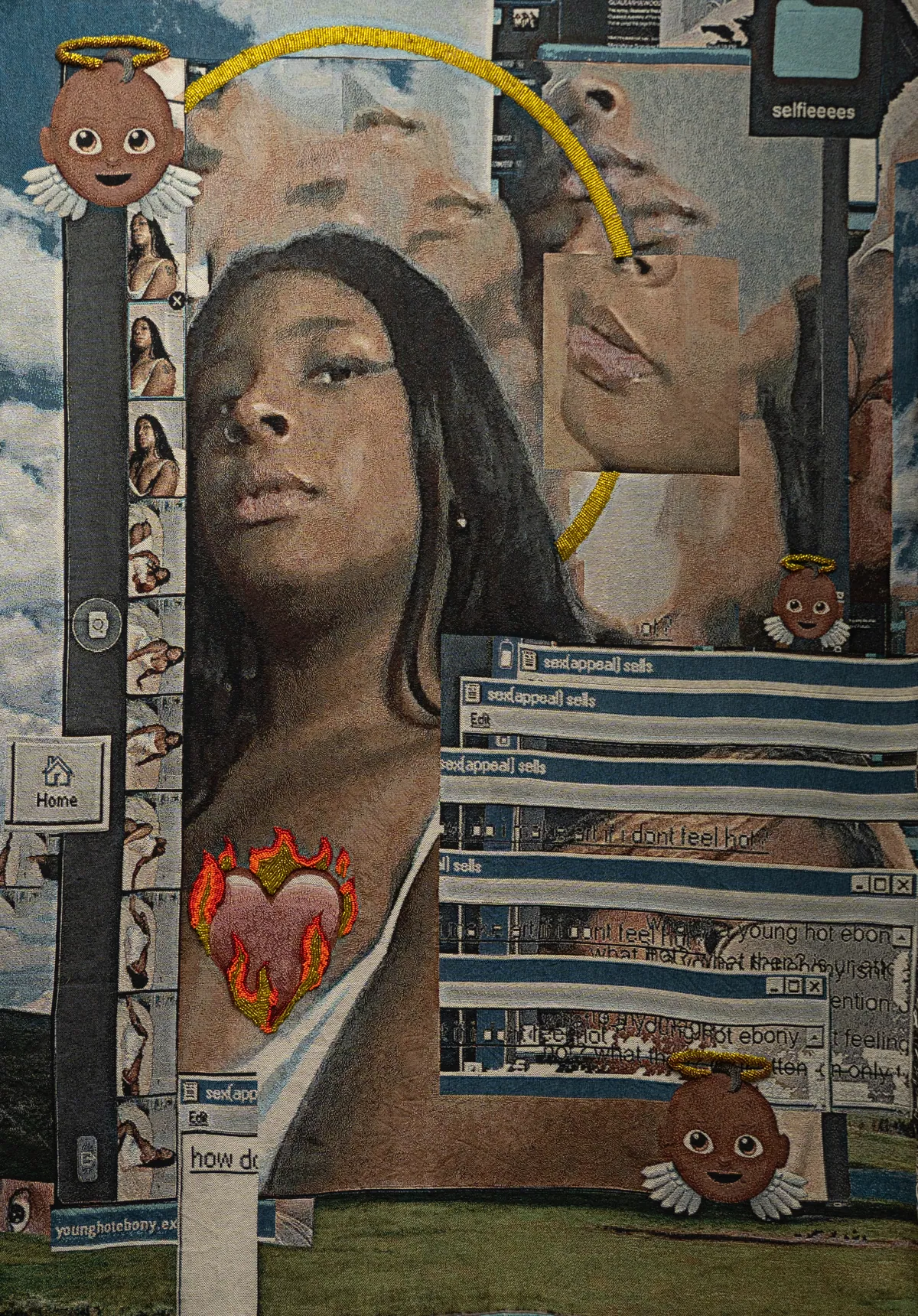
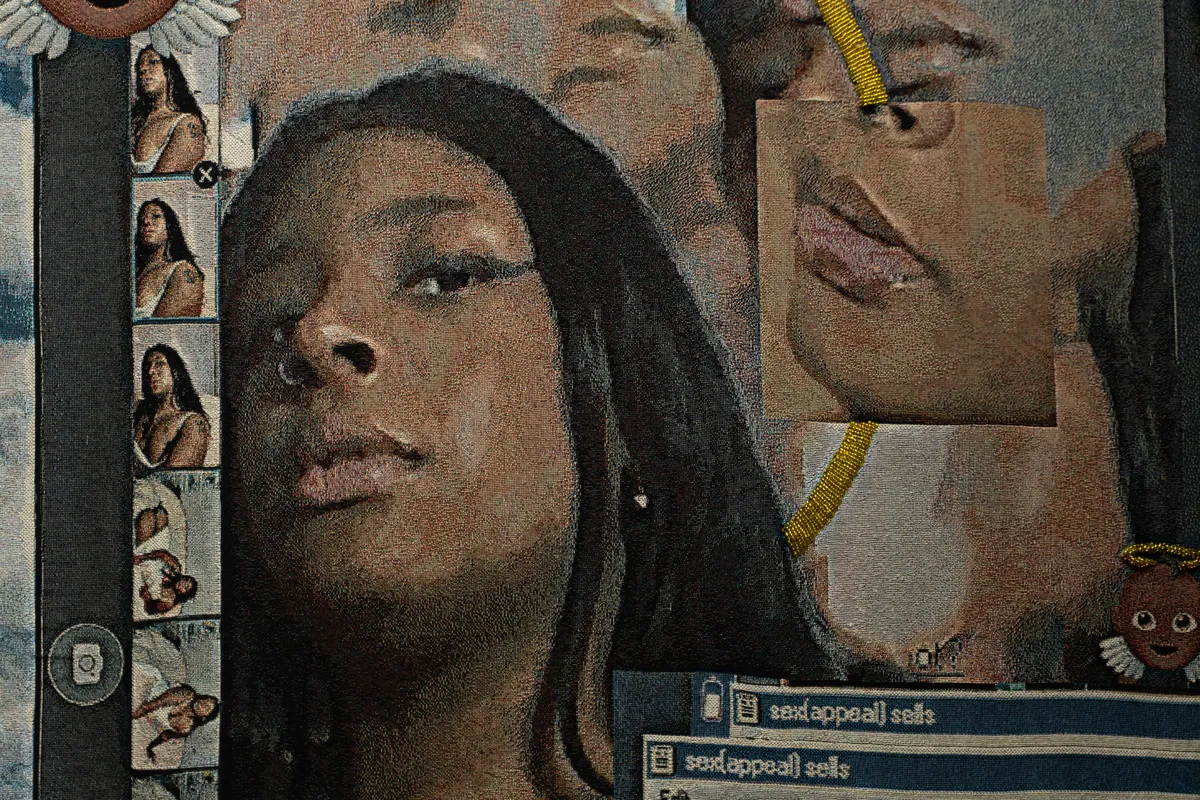
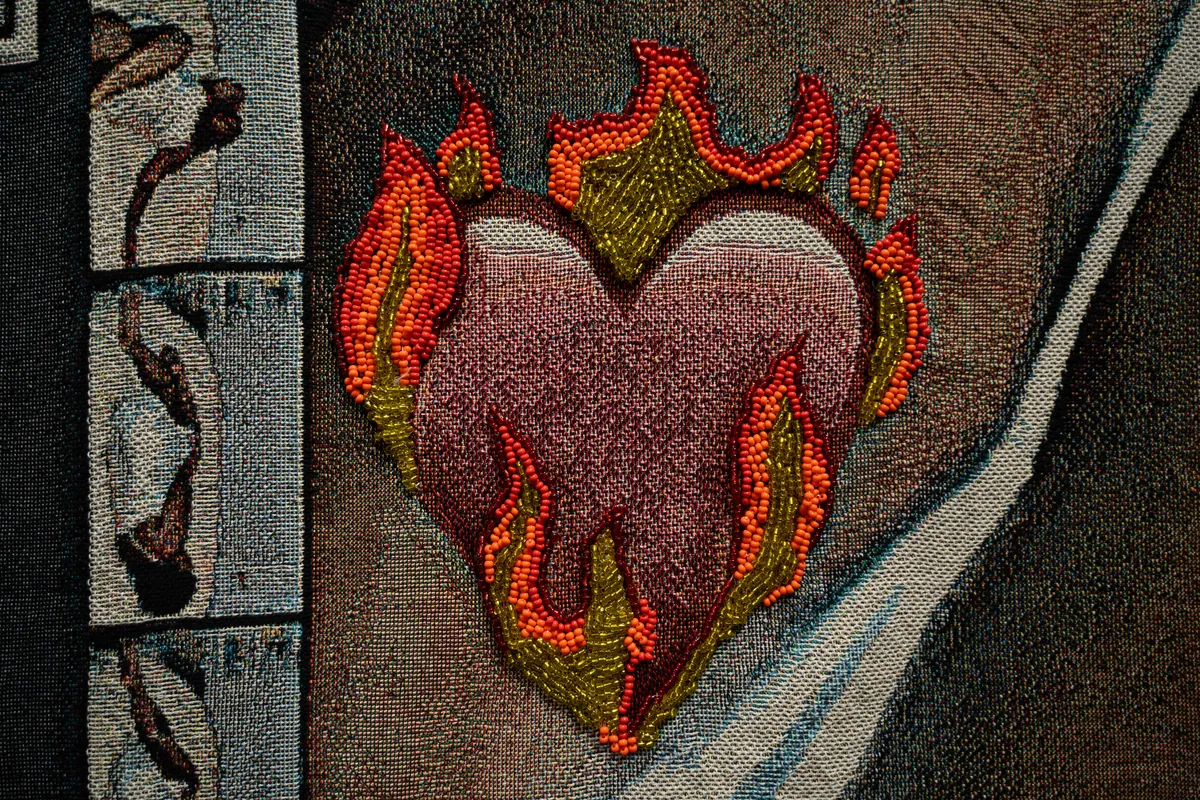
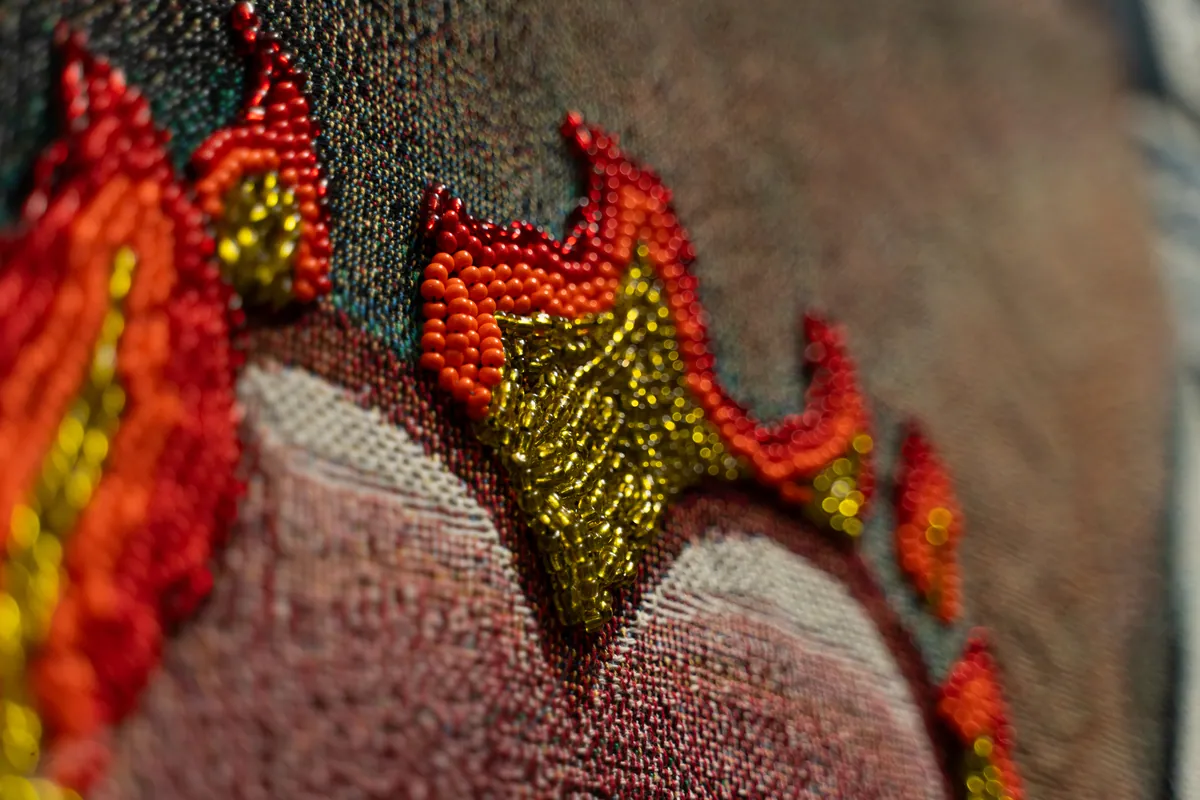
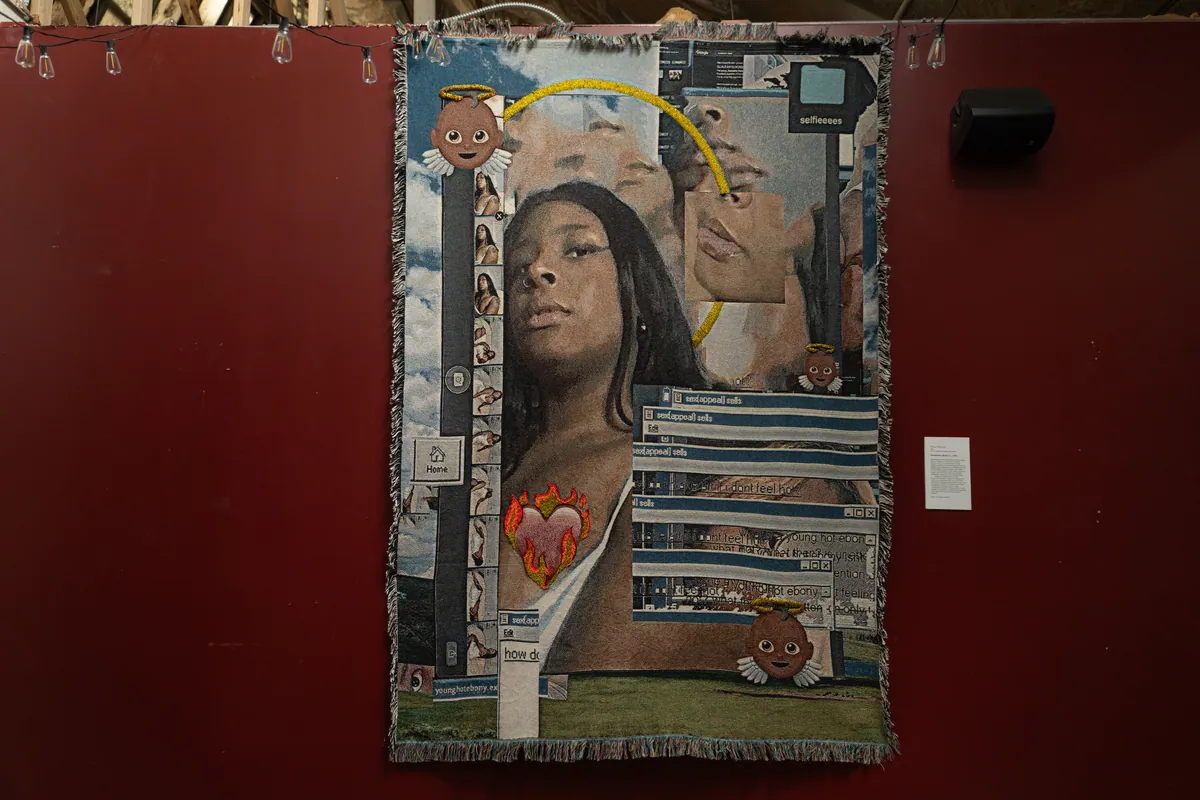
A woman looks up and out of a woven field that has been overrun by the interface: stacked chat windows, a scroll of thumbnails down the left edge, cherub emoji hovering at the corners like minor saints. Wood builds these on a digital jacquard loom, where one pixel becomes one stitch, then returns to the surface by hand with glass seed beads. The flaming sacred heart at the centre of the chest is raised in that beadwork, and it is the one element you cannot screenshot: it has to be stood in front of. That is the argument of the piece. An image born to be scrolled past has been made slow, heavy and permanent enough to hang on a wall.
Wood took her BFA at the Rhode Island School of Design and her MFA at Cranbrook Academy of Art. She works in digital jacquard weaving, hand-sewn embroidery and beadwork, using selfies and screen capture as raw material to examine how Black femme cultural production is prized while Black femme bodies are held at the margins. Her work entered the collection of the Metropolitan Museum of Art while she was still in her twenties, and she is represented by Hauser & Wirth.
In the House
02
Solitude
Emma Prempeh
b. 1996, London. Ghanaian and Vincentian heritage
- Year
- 2022
- Medium
- Oil, acrylic, print, and imitation gold leaf on canvas
- Size
- Not recorded
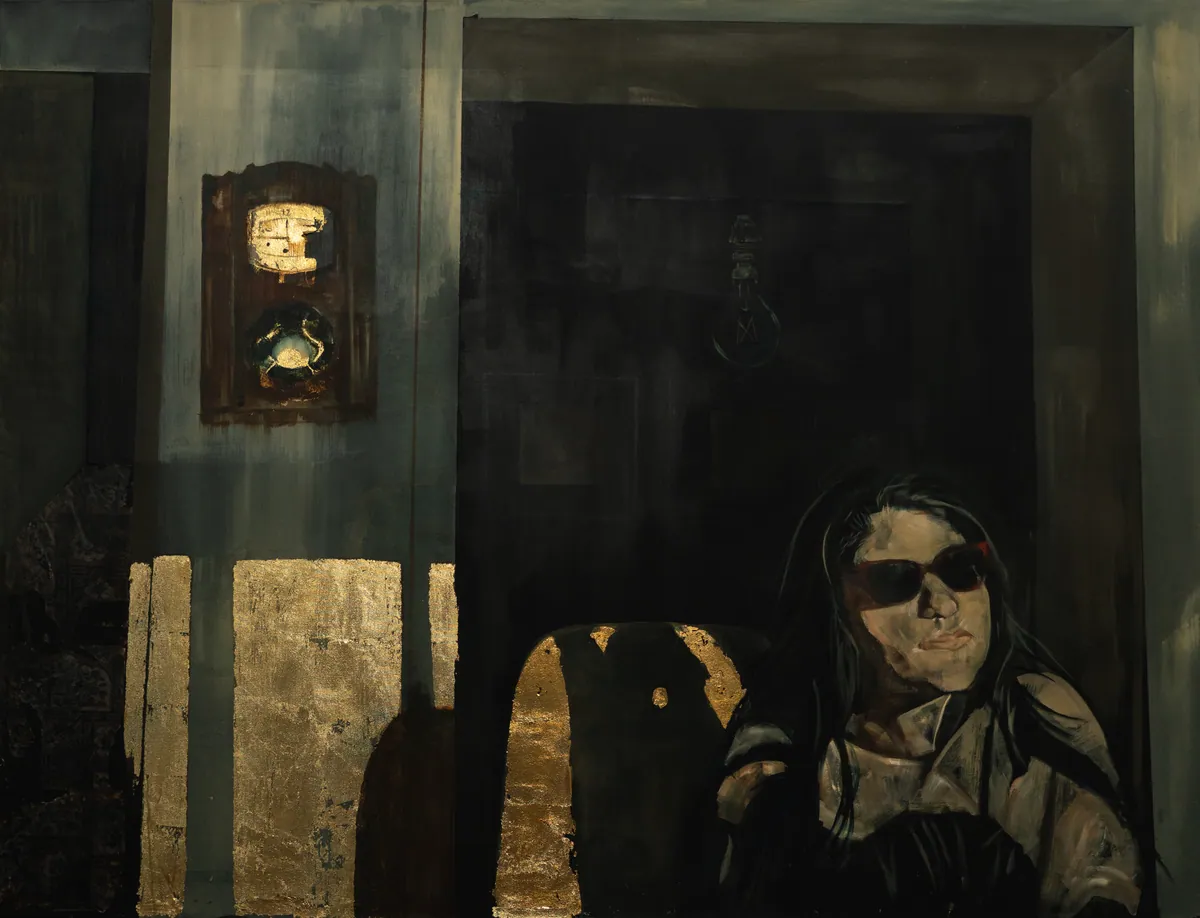
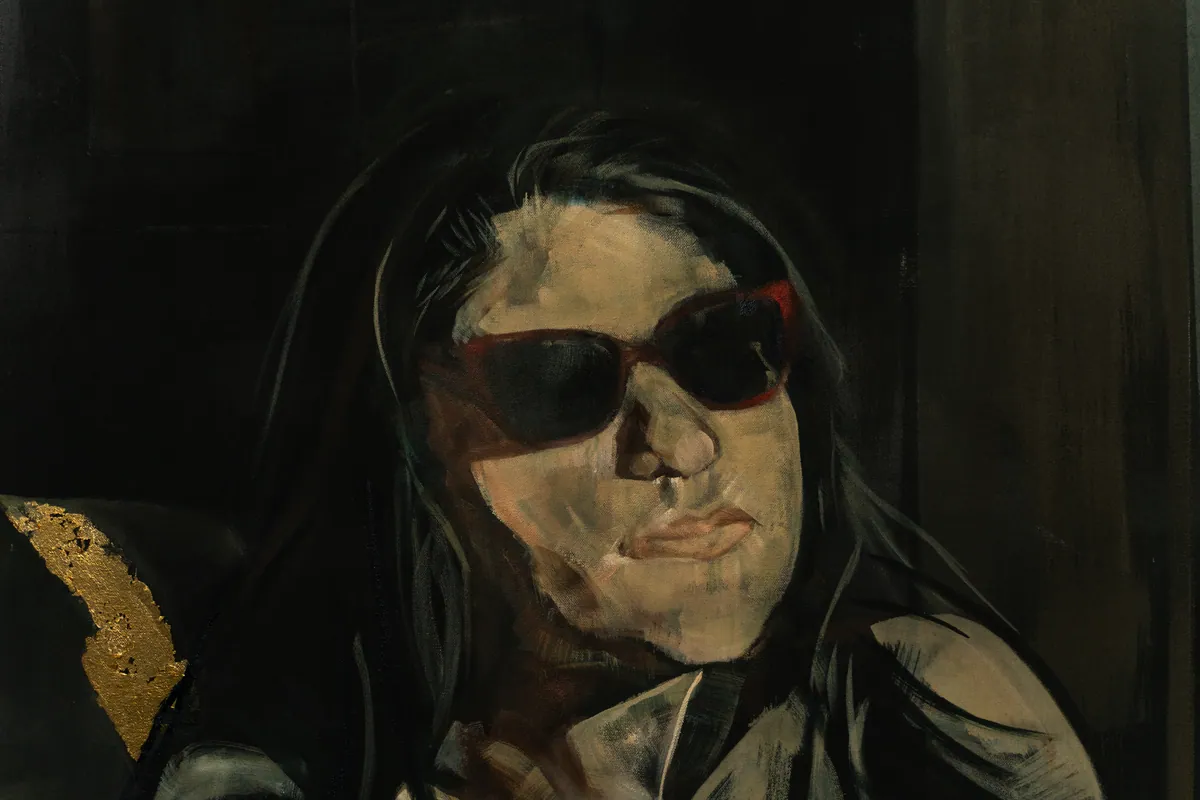
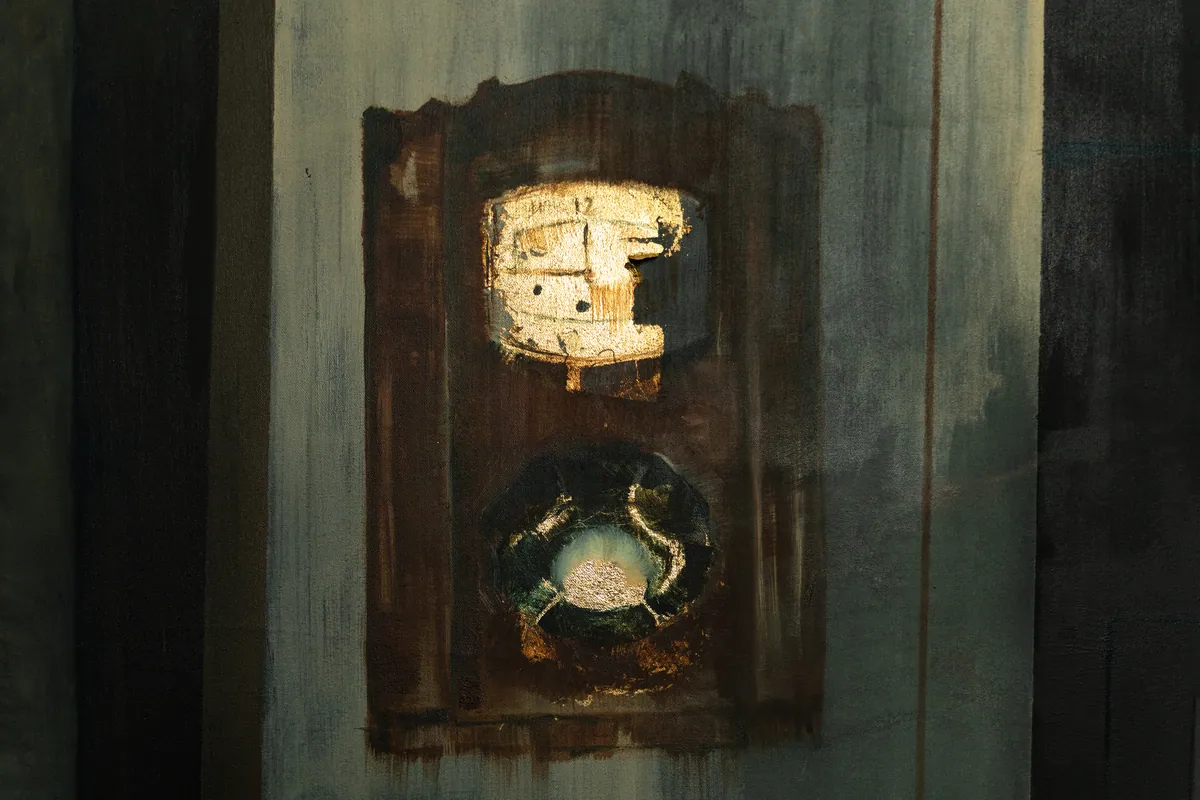
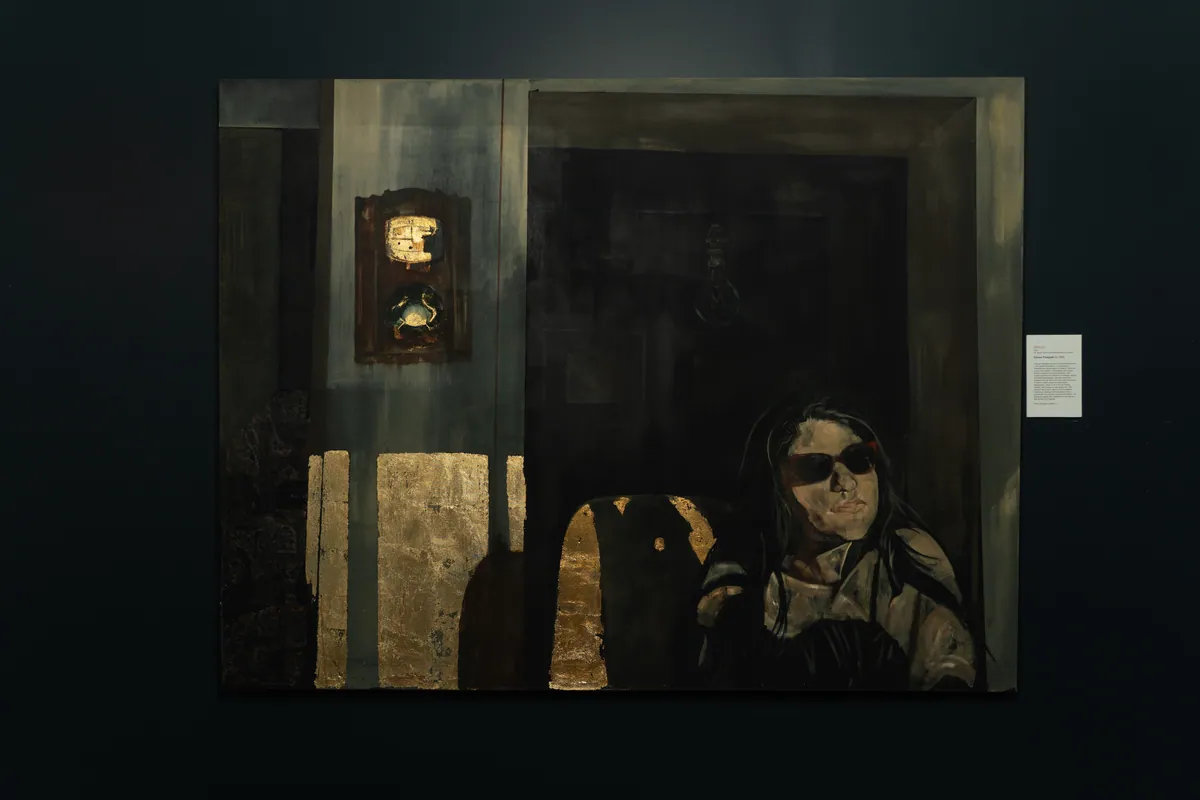
A figure sits in near-darkness in sunglasses, half-turned, while a clock glows on the wall behind her in beaten metal. Prempeh begins her paintings from blackness, not as absence but as the tonal ground everything else has to climb out of, and then lays in the imitation gold leaf on the label. Schlagmetal is a copper and zinc alloy that stands in for gold. Schlagmetal oxidises. The metal in this painting is not fixed; it will darken and shift on the wall over years, which means the picture keeps its own time and will not look the same to the next person who sits with it. A painting about memory that is itself quietly changing.
Prempeh studied at Goldsmiths and took her MA in Painting at the Royal College of Art on a Leverhulme Trust scholarship, winning the Valerie Beston Trust Arts award in 2022. Her work moves through magical realism and diaspora, asking what belonging means for those who feel in-between, and is held in UK public collections.
In the House
03
The Wisdom from Above
Rita Mawuena Benissan
b. 1995, Abidjan, Côte d’Ivoire. Ghanaian American, based in Accra
- Year
- 2024
- Medium
- Embroidery on velvet
- Size
- Not recorded
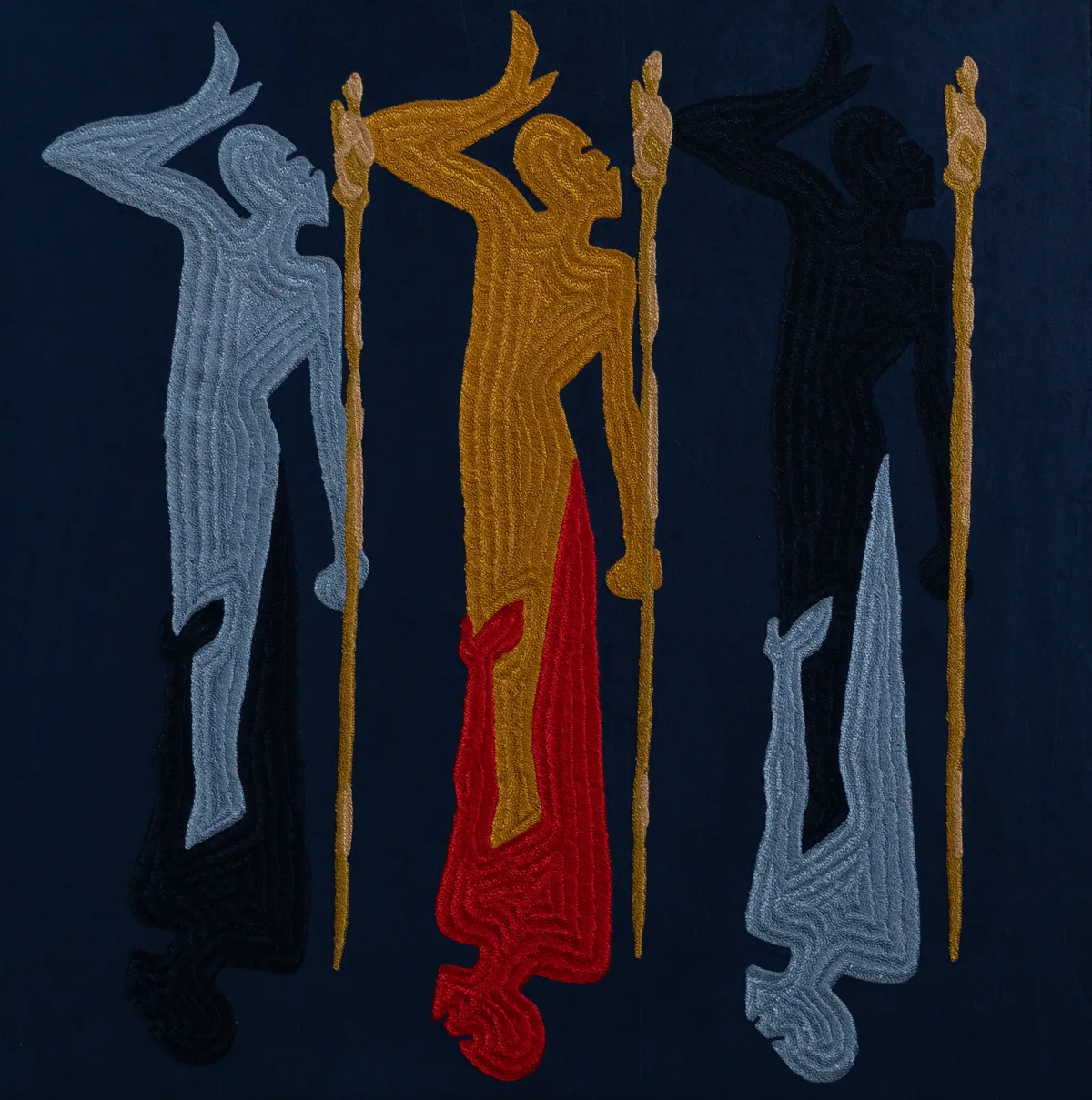
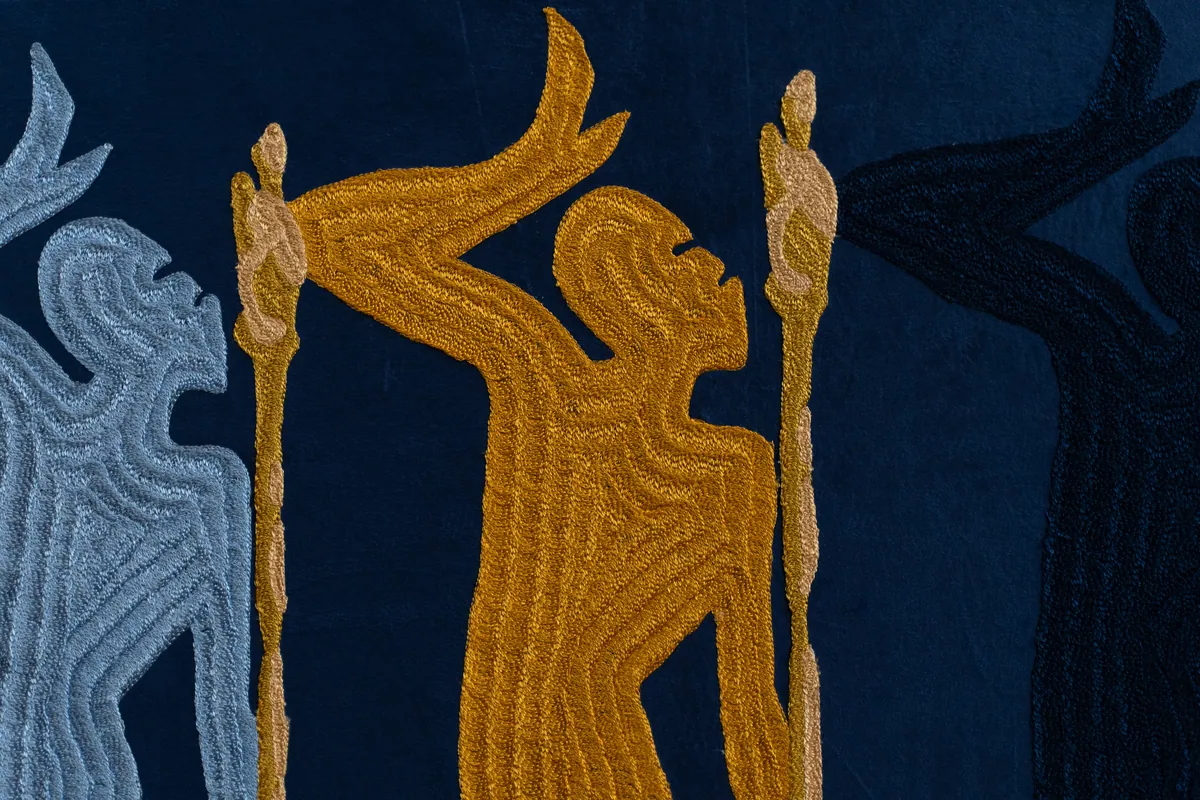
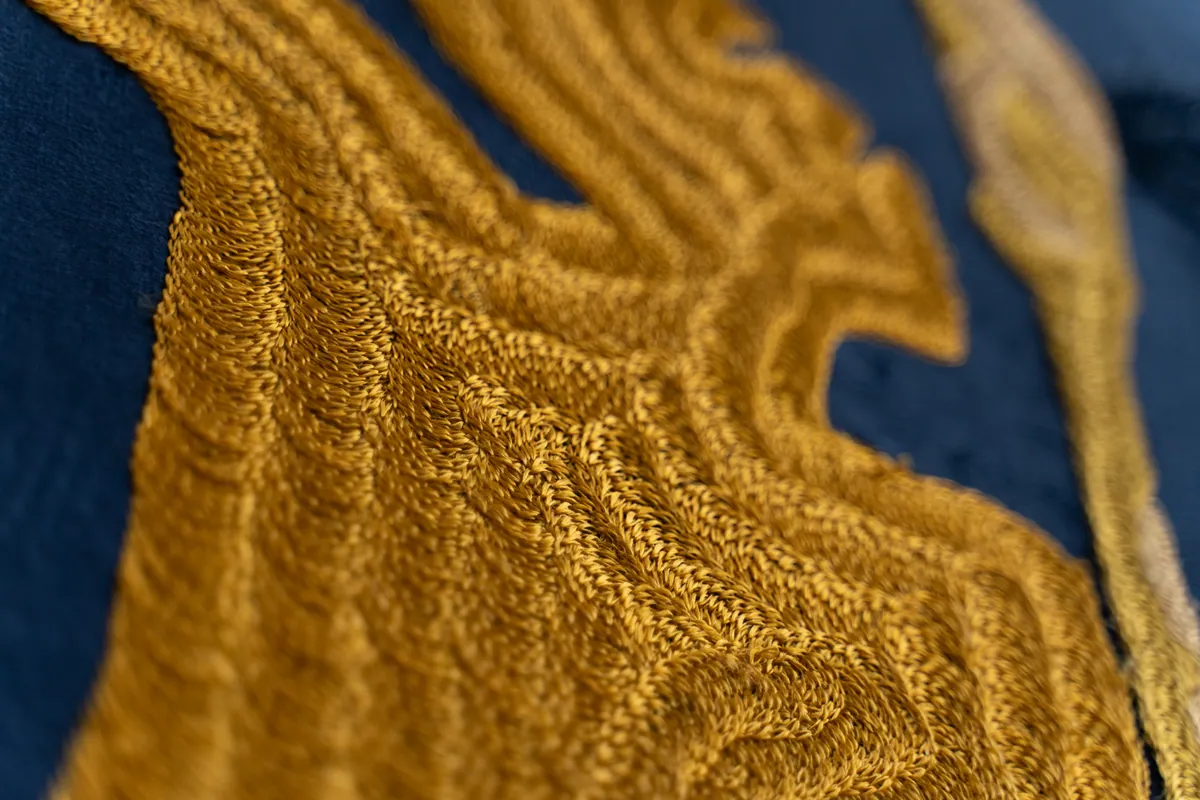
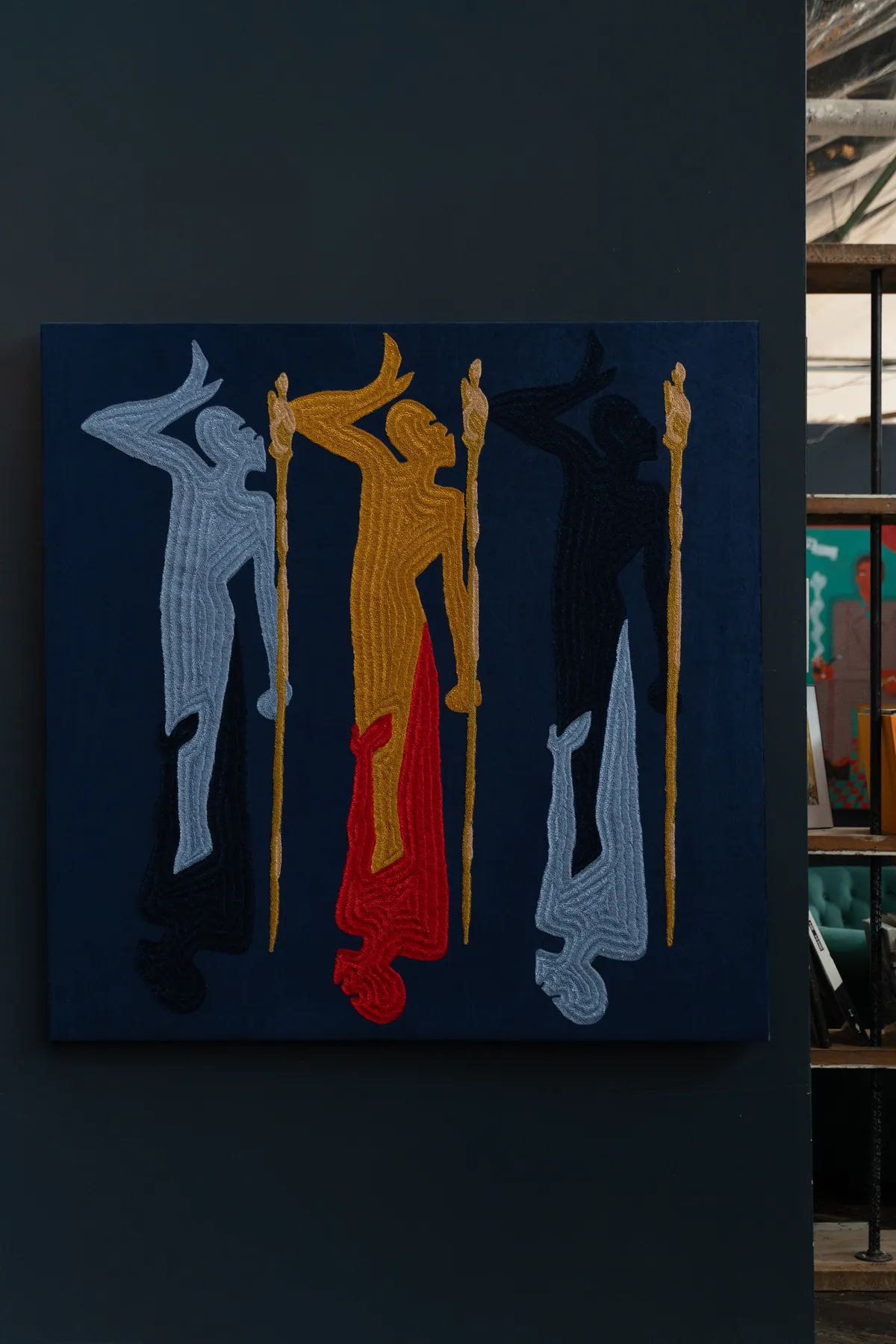
Five figures stand on an indigo velvet ground, each holding a staff, worked entirely in dense corded embroidery: pale blue, gold, black, and a single figure in red who has been turned upside down. The vocabulary is Ghanaian court regalia: the linguist’s staff, the colour and hierarchy of the royal umbrella under which a chief is seated. Benissan collaborates with traditional umbrella makers in Kumasi and with skilled embroiderers, so the making of the object is itself an act of preservation. Up close the gold is a landscape of ridged thread, catching light the way the real regalia does in procession. Read left to right it behaves less like a picture than like a line of praise poetry.
Benissan took a BFA in Apparel and Textile Design at Michigan State and an MFA in photography at the University of Wisconsin–Madison. She reimagines the Ghanaian royal umbrella as a symbol of national identity across textile, photography, sculpture and installation, and in 2020 founded Si Hene, a foundation dedicated to preserving Ghana’s chieftaincy and traditional culture.
In the House
04
Munzvimbo Yaunofamba Nekudzoka Wega I
(In the Space You Walk and Return Alone I)
Virginia Chihota
b. 1983, Chitungwiza, Zimbabwe. Based in New York
- Year
- 2022
- Medium
- Serigraphy on linen canvas
- Size
- Not recorded
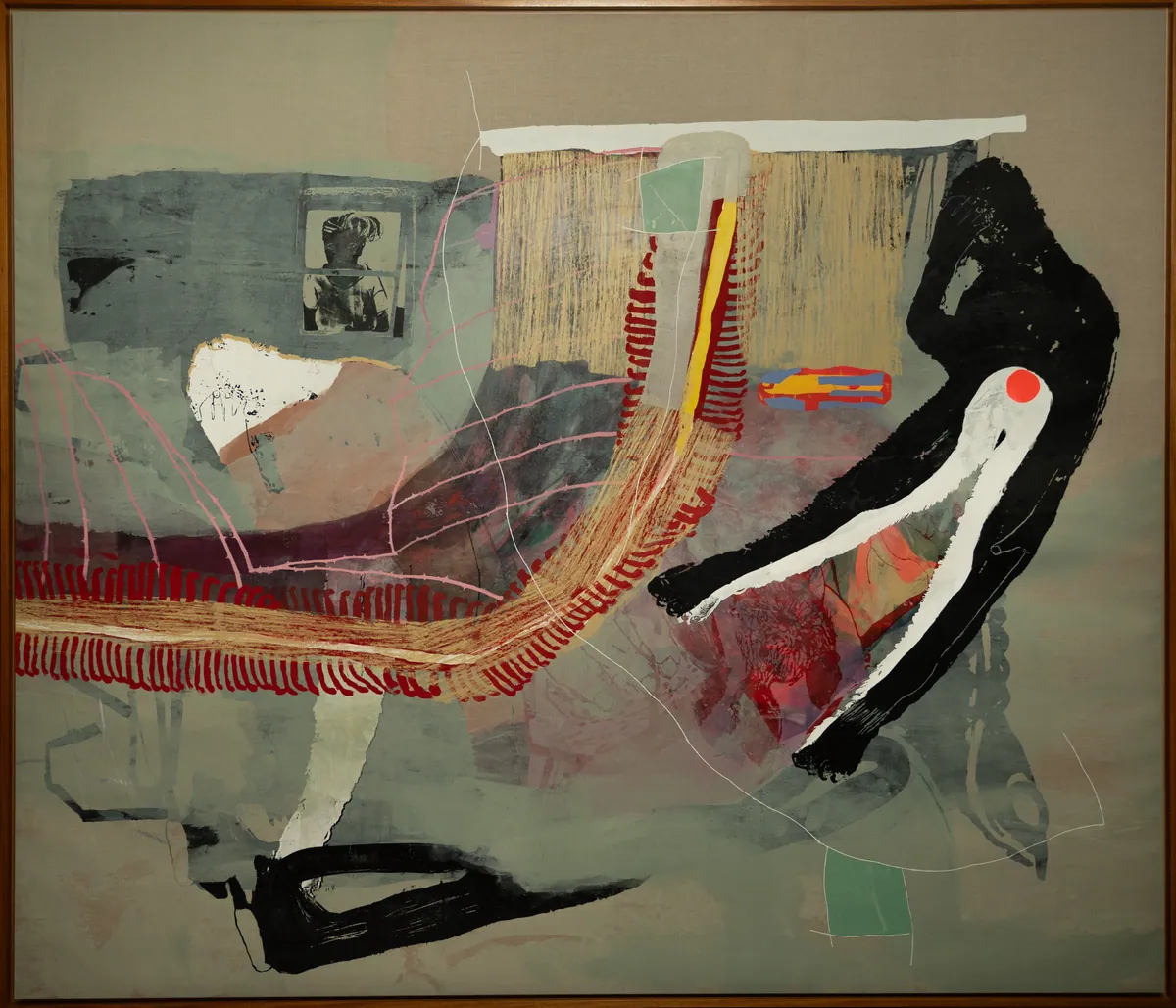
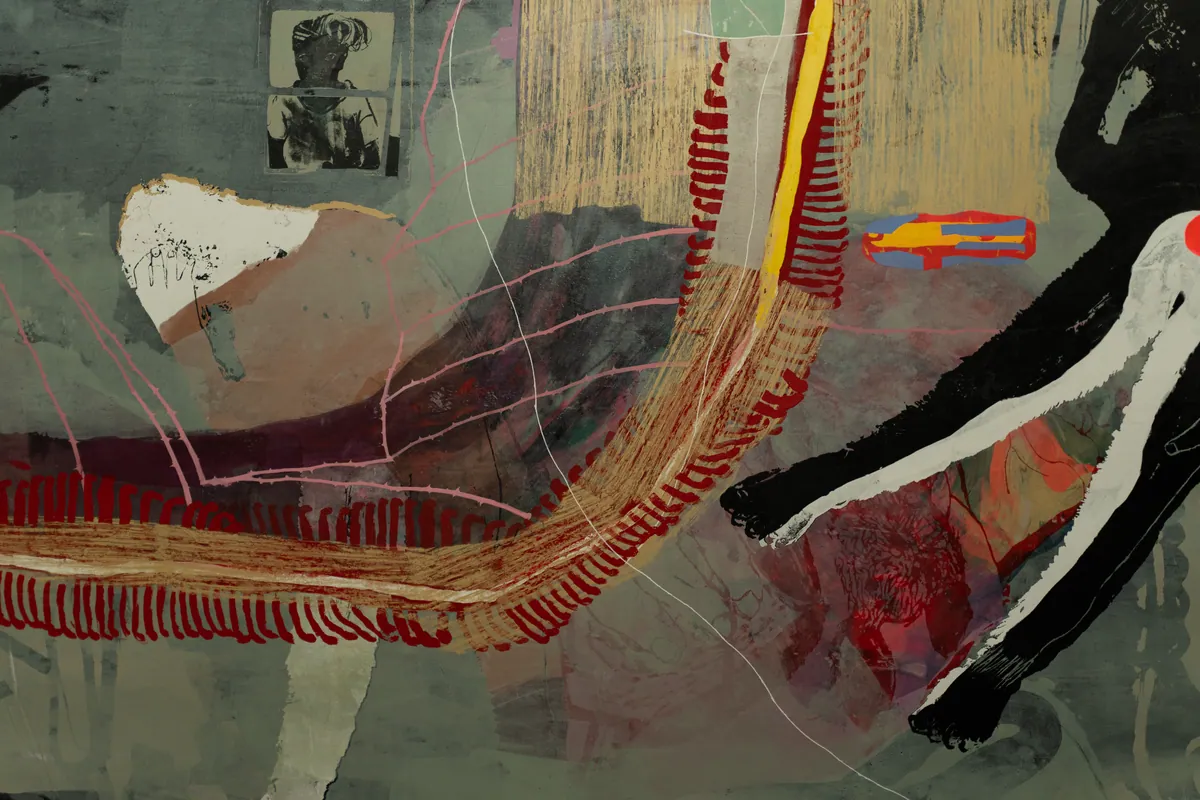
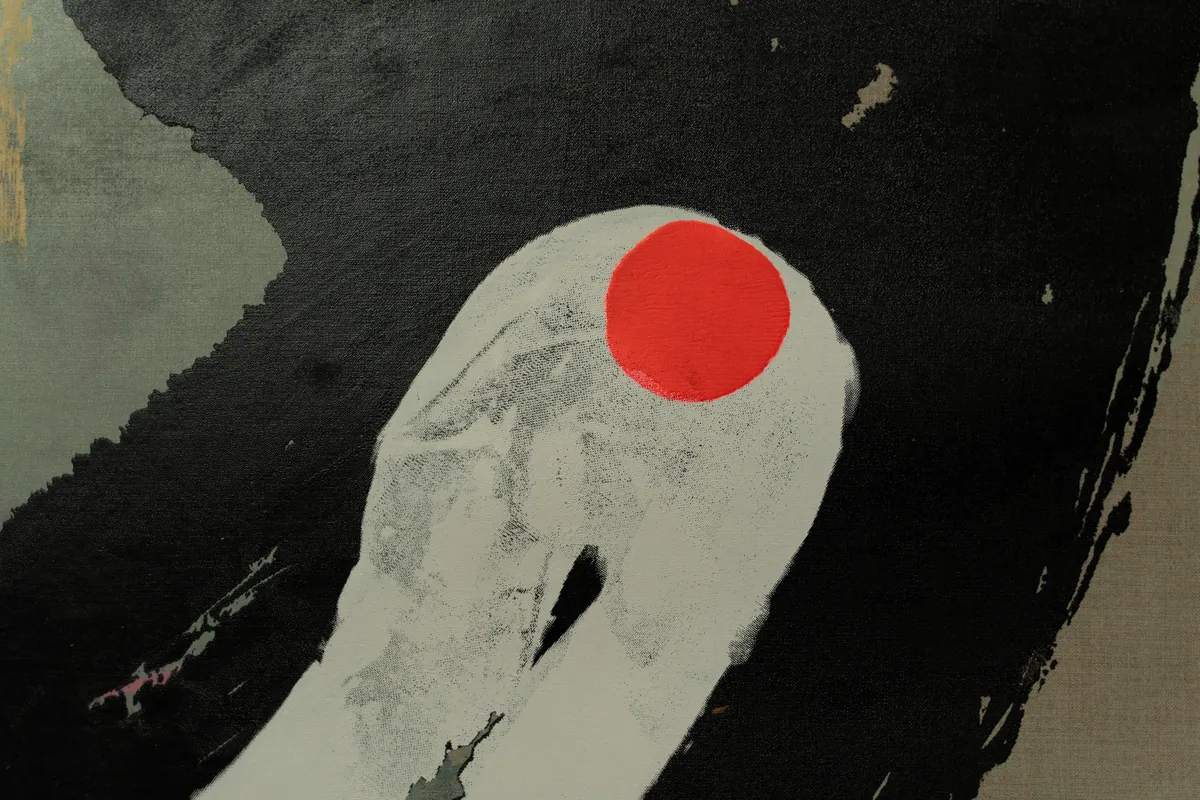
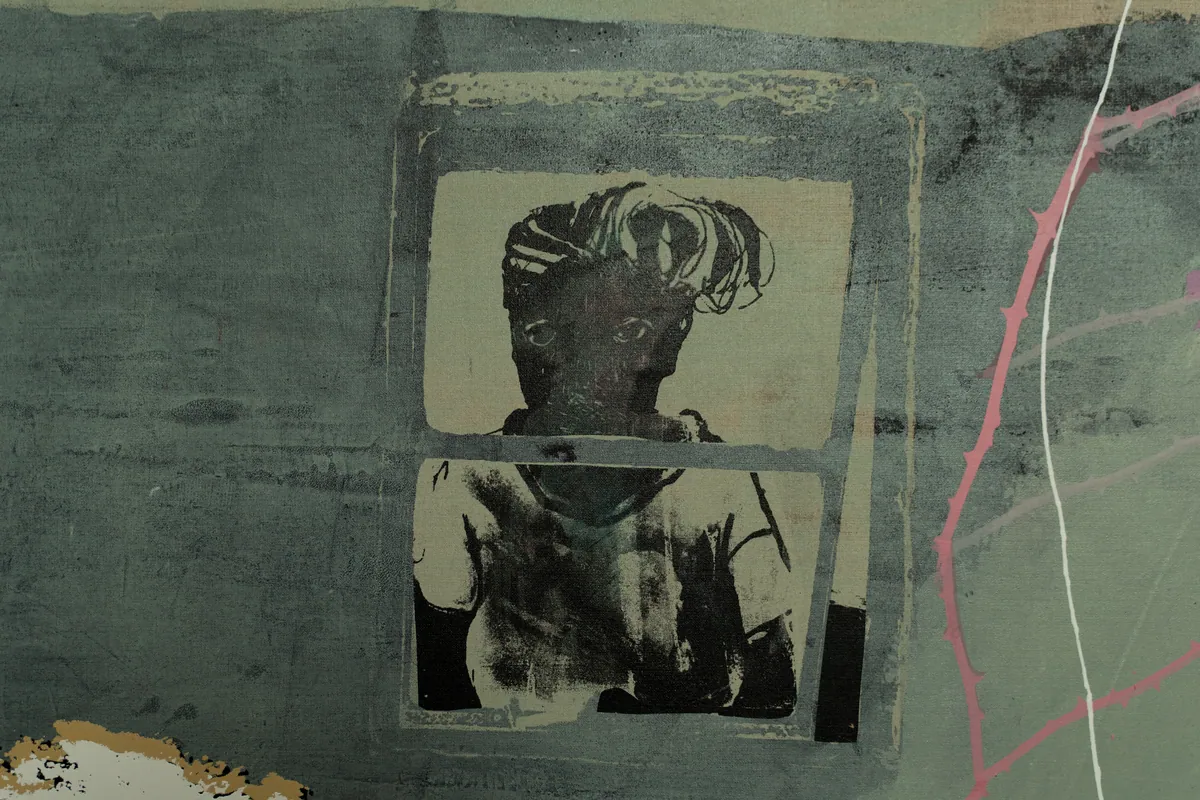
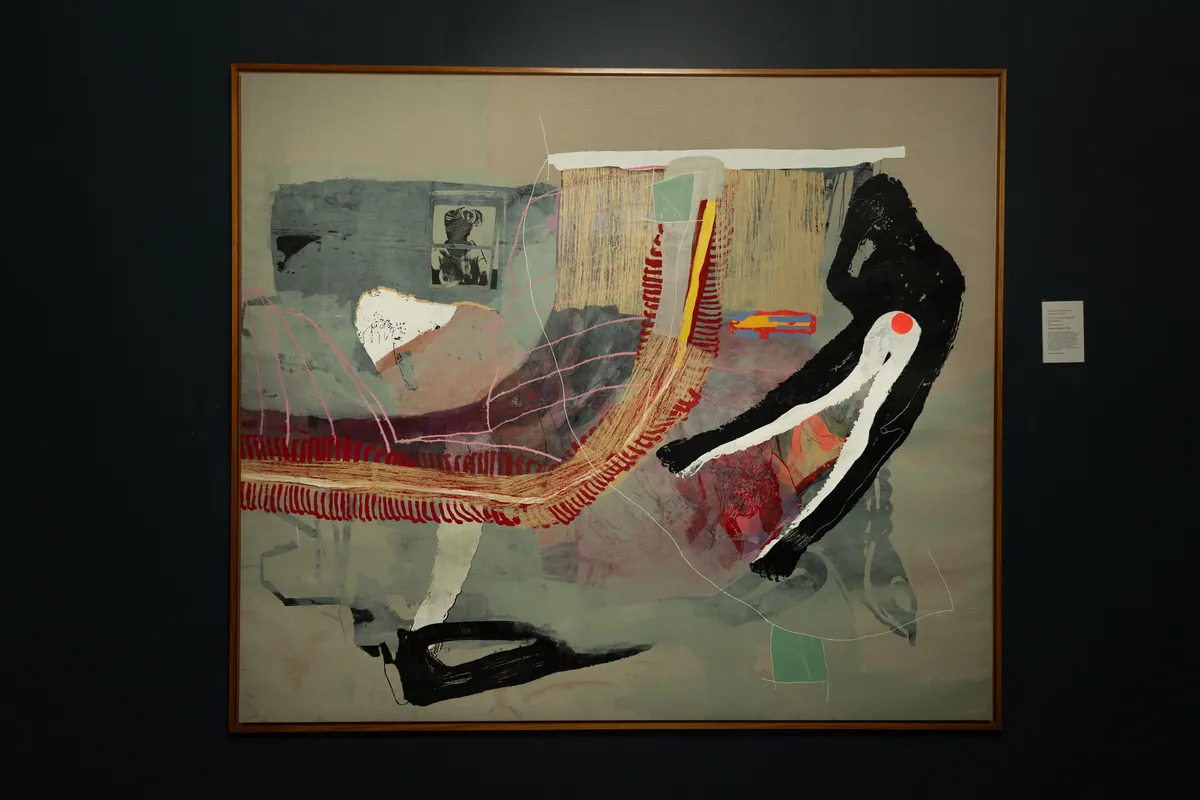
A large sheet of muted grey-green in which bodies are only ever partly available: a dark limb arcing across the centre, a white form beneath it marked with one hard red circle, a small portrait printed into the surface like a photograph pinned to a wall. The whole thing is screenprinted onto linen, and the layering is doing the emotional work: figures surface and are pulled back under, edges dissolve into the ground, ink floats rather than sits. The title is the whole proposition. It names a passage that cannot be shared, and the picture refuses to resolve into a scene you could stand outside of and describe.
Chihota graduated in Fine Arts from the National Art Gallery Studios in Harare in 2006 and represented Zimbabwe at the 55th Venice Biennale in 2013. She now lives and works in New York. Her practice sits at the intersection of printmaking and drawing, and takes up childbearing, childrearing, marriage, kinship, bereavement and faith through the often marginalised bodies of African women.
In the House
05
Perspective of Rua Araújo, Lourenço Marques
Cassi Namoda
b. 1988, Maputo, Mozambique
- Year
- 2019
- Medium
- Acrylic on canvas
- Size
- Not recorded
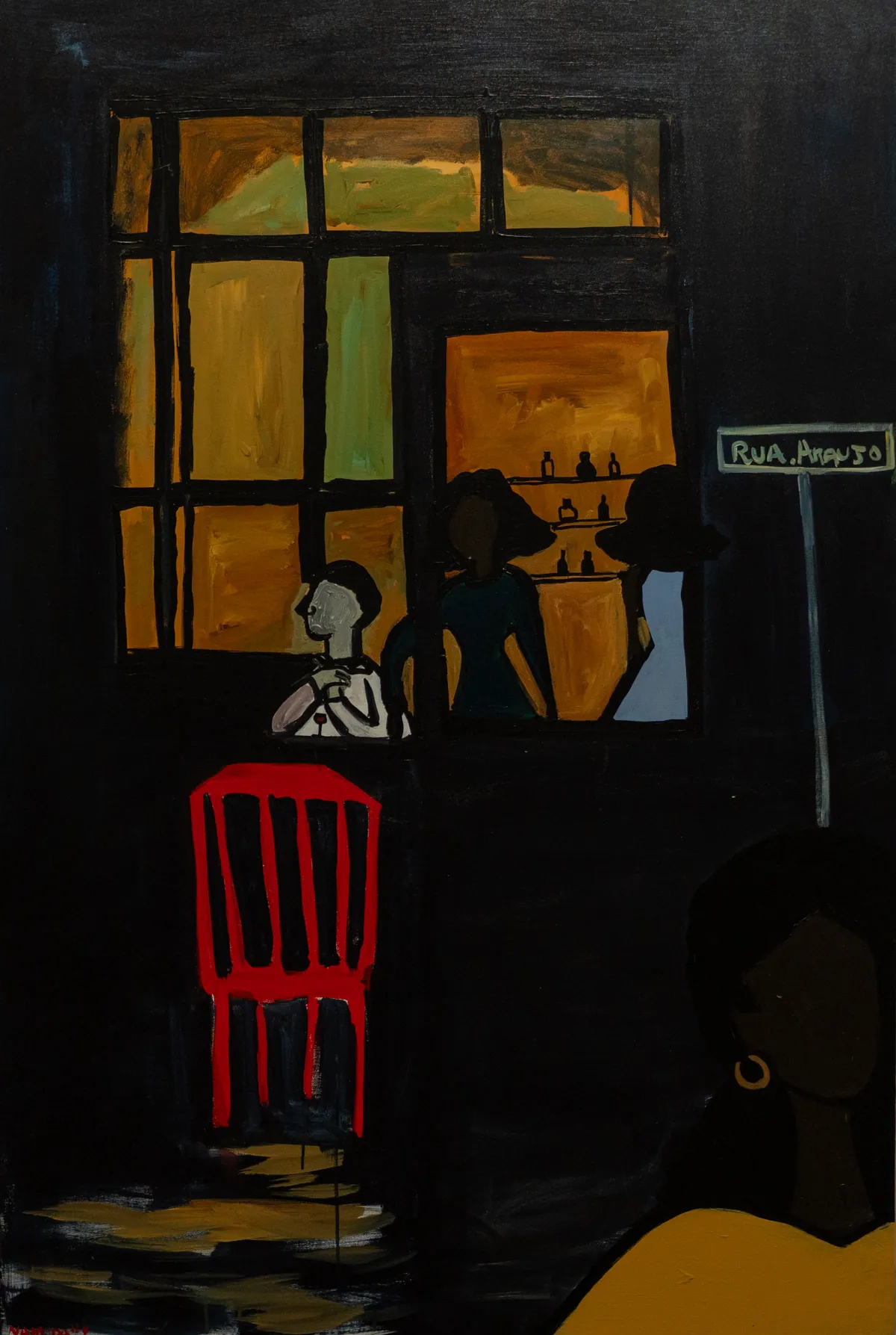
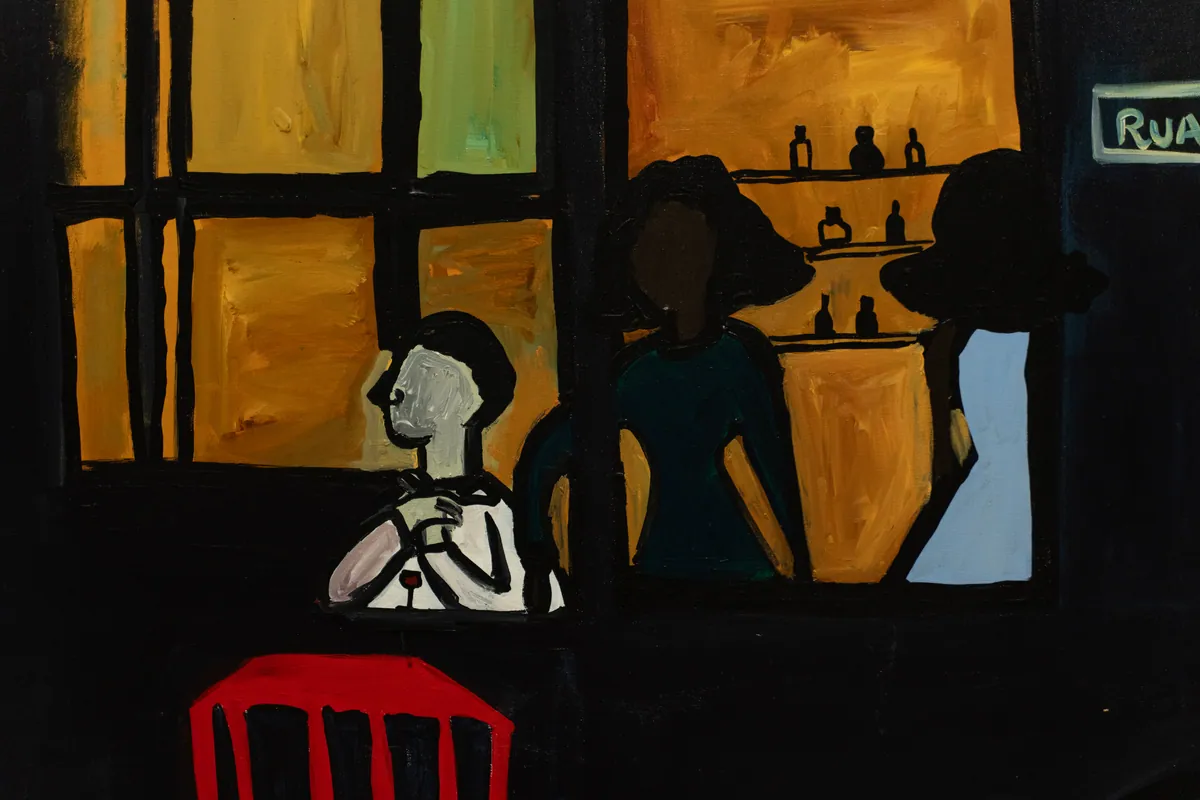
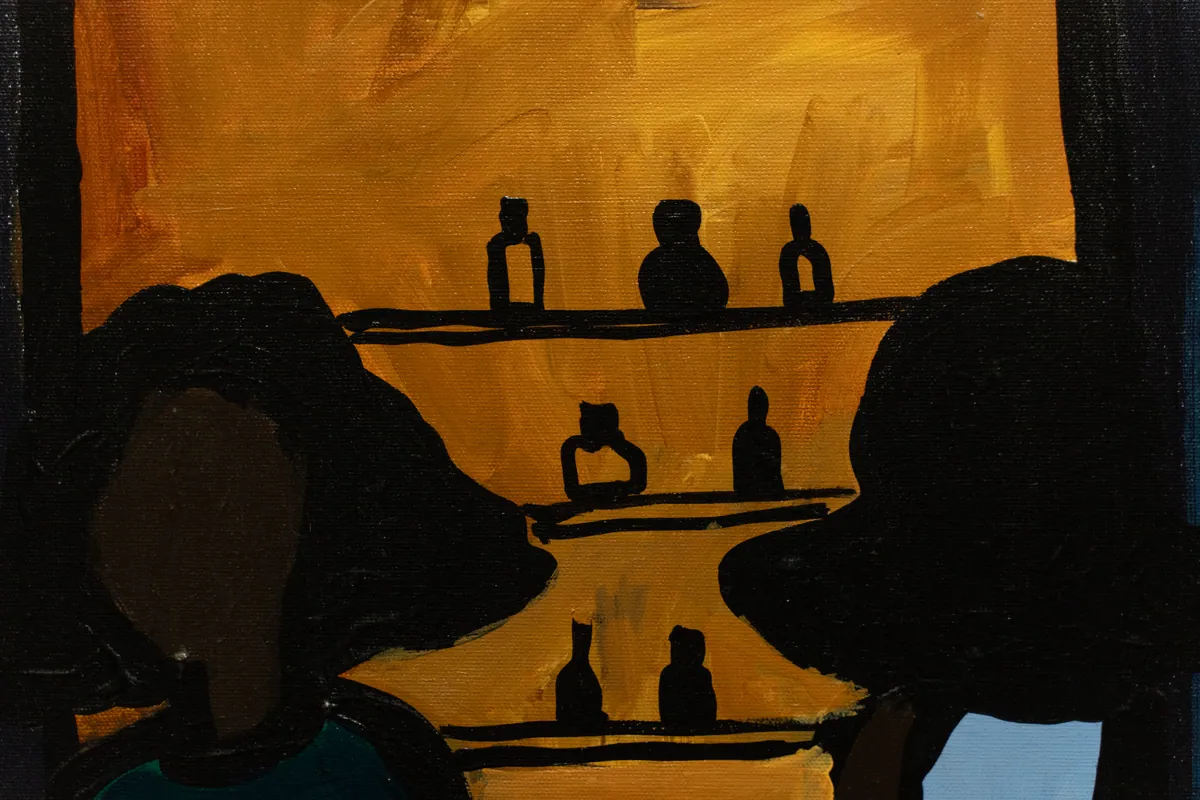
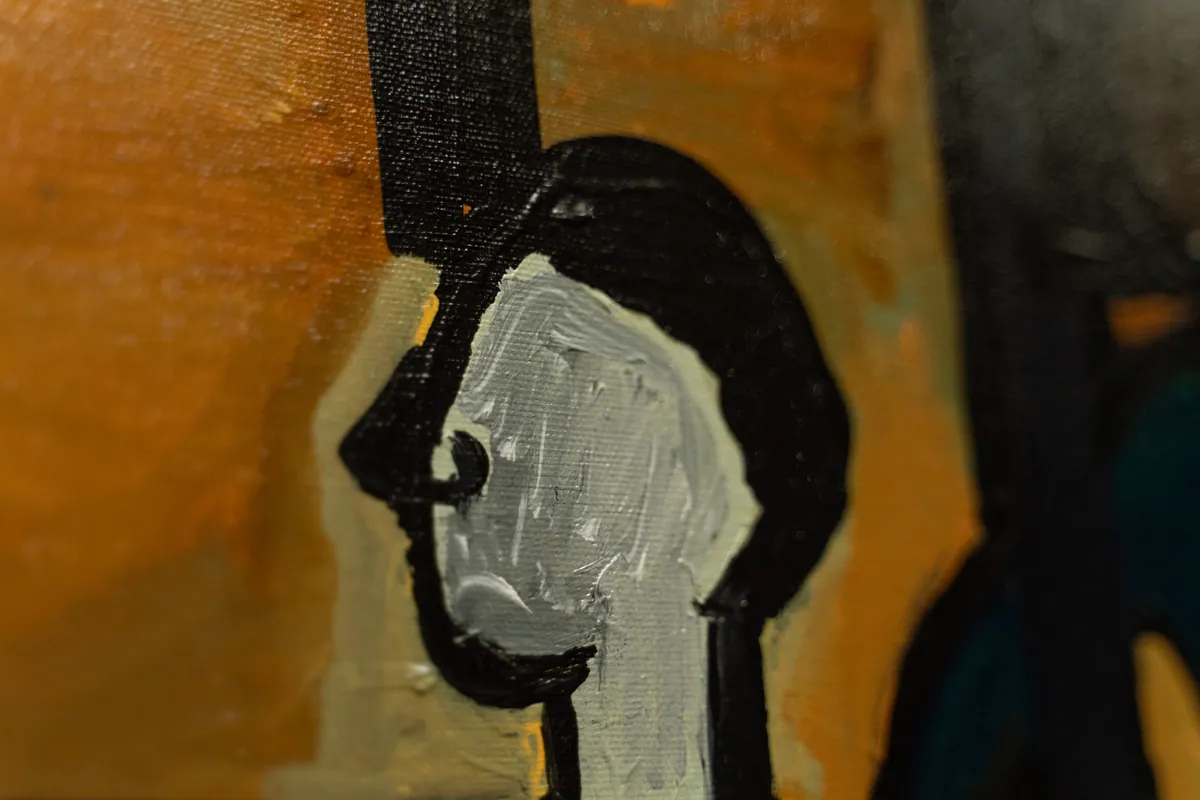
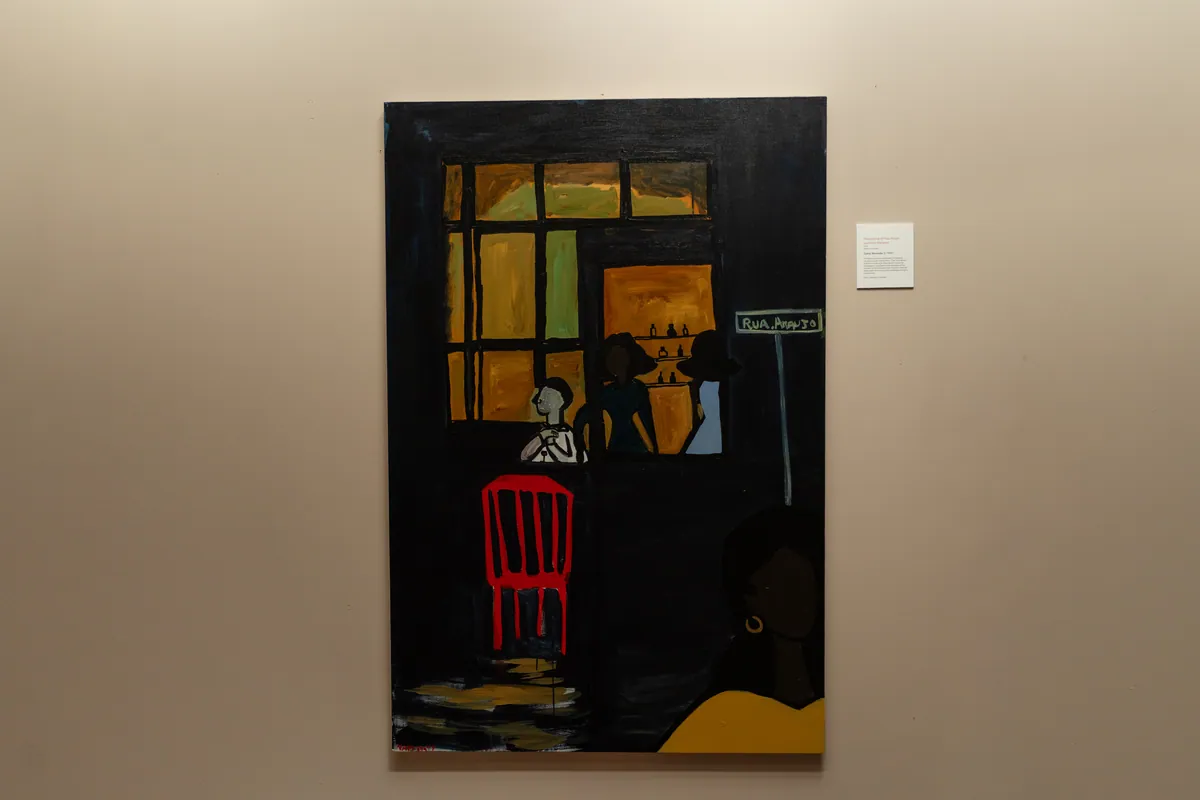
A bar at night, reduced to its essentials: a lit window the colour of amber, bottles ranked on a shelf, a red chair holding the foreground like a struck note, and figures rendered as flat silhouettes who face away or into the light. Rua Araújo, in the city the Portuguese called Lourenço Marques and which is now Maputo, was the red-light district, a street Namoda has returned to as a way of painting colonialism without painting an argument about it. Nobody in the picture is explaining anything. The scene is warm and almost companionable, and the discomfort sits underneath, in who is lit and who is only shape.
Namoda was born in Maputo and raised between Mozambique, Haiti and the United States, and studied cinematography at the Academy of Art University in San Francisco. Her figurative paintings transfigure the cultural mythologies and historical narratives of post-colonial Africa through a surrealist lens, pulling on architecture and vernacular photography and returning often to the bars, streets and social spaces of Lourenço Marques.
In the House
06
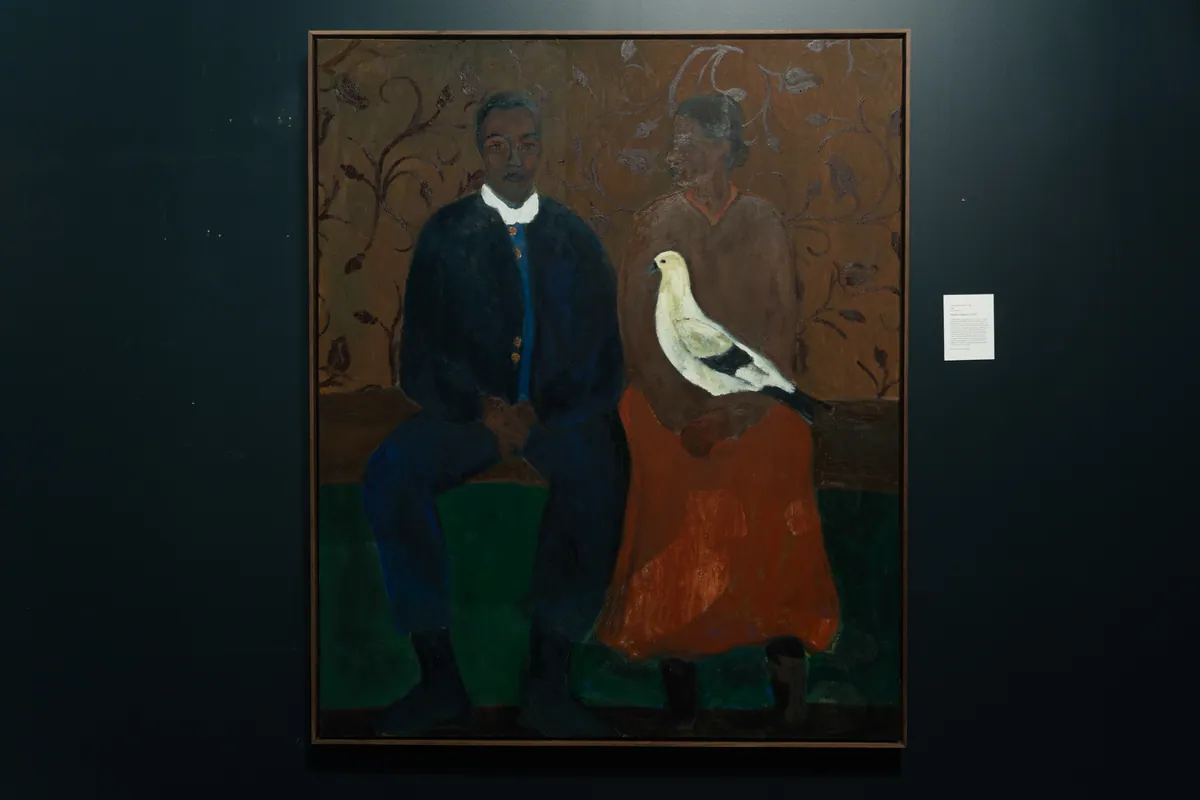
The Peaceful Pair
Patrick Eugène
b. 1984. Haitian American, based in Atlanta
- Year
- 2024
- Medium
- Oil on canvas
- Size
- Not recorded
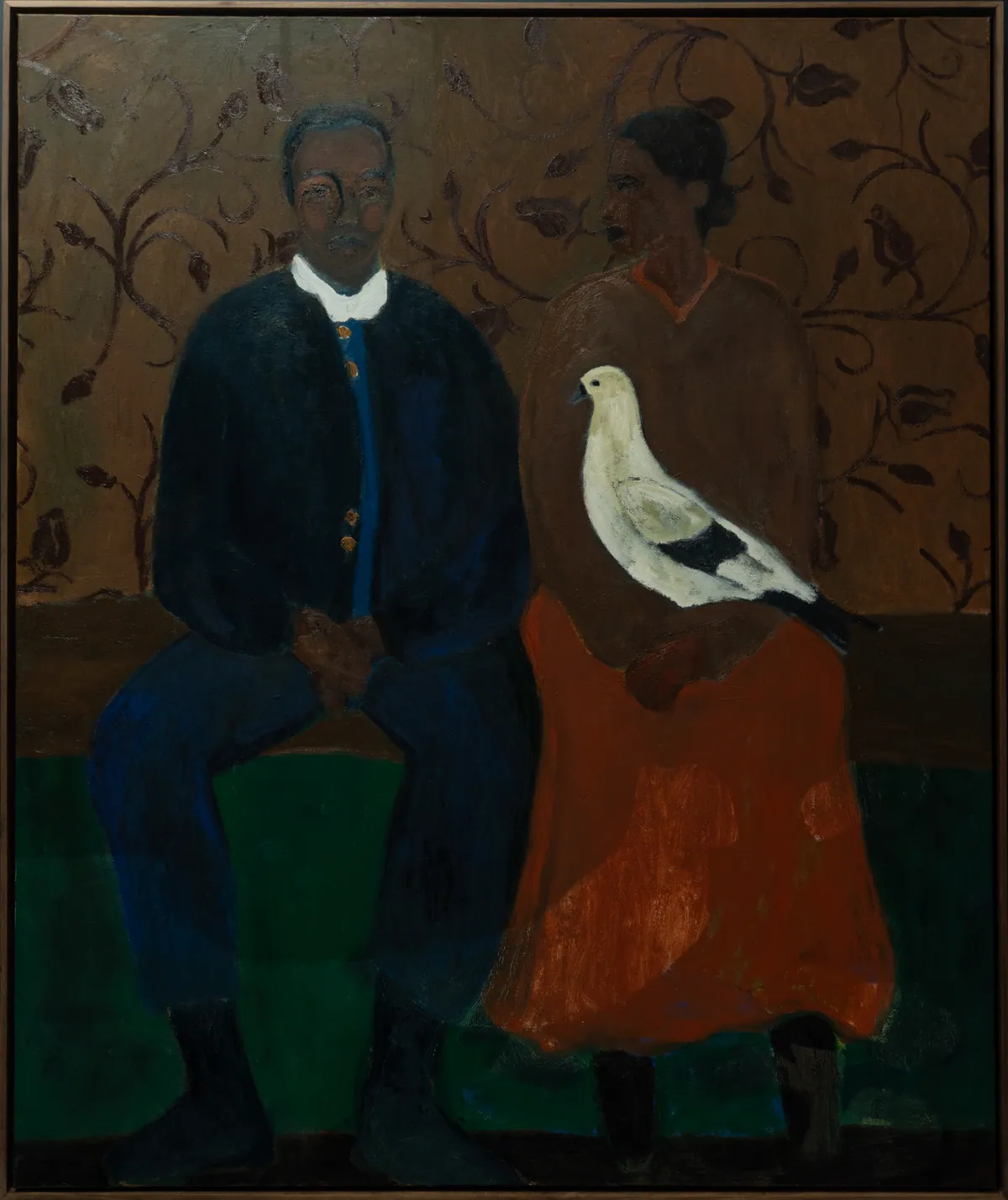
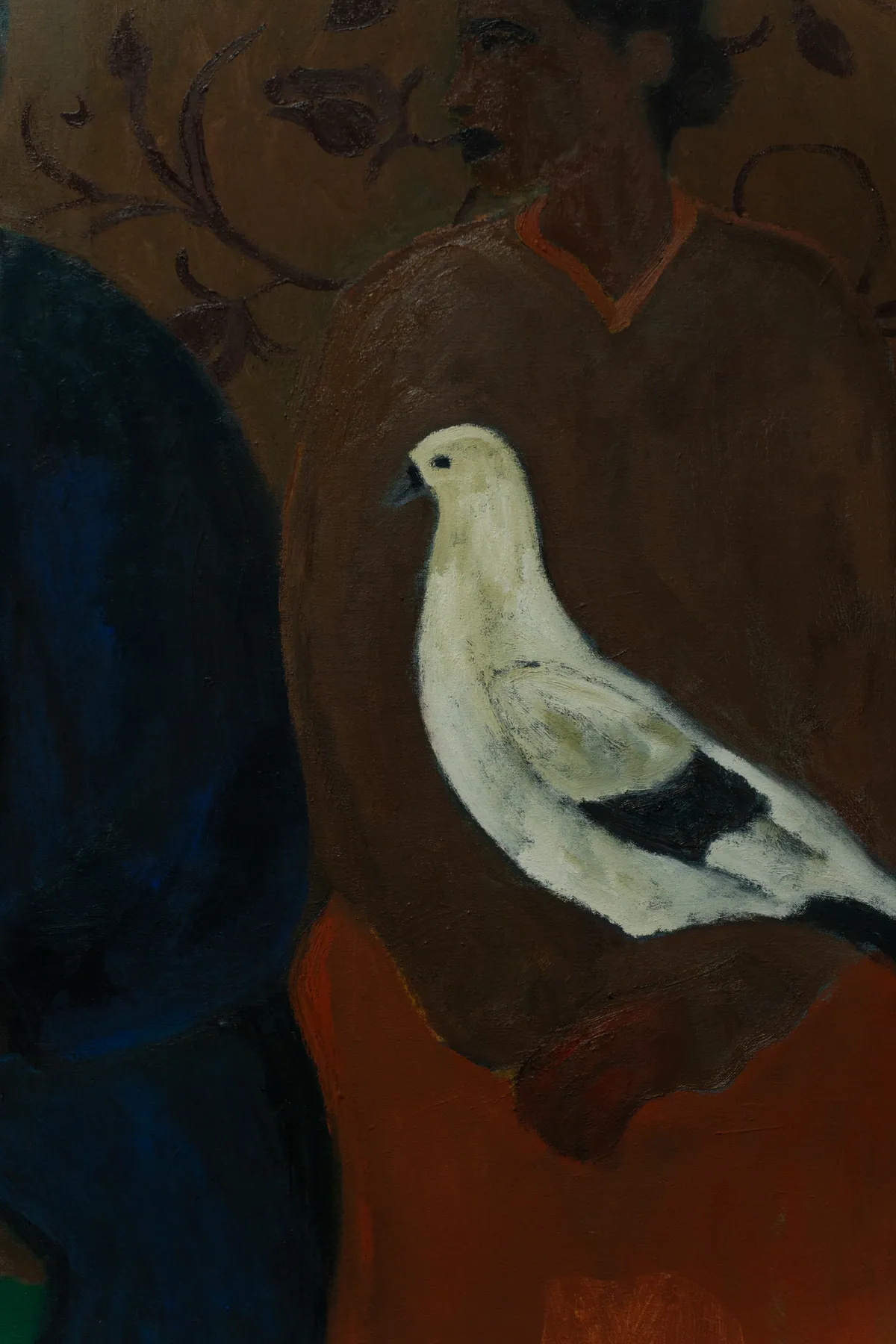
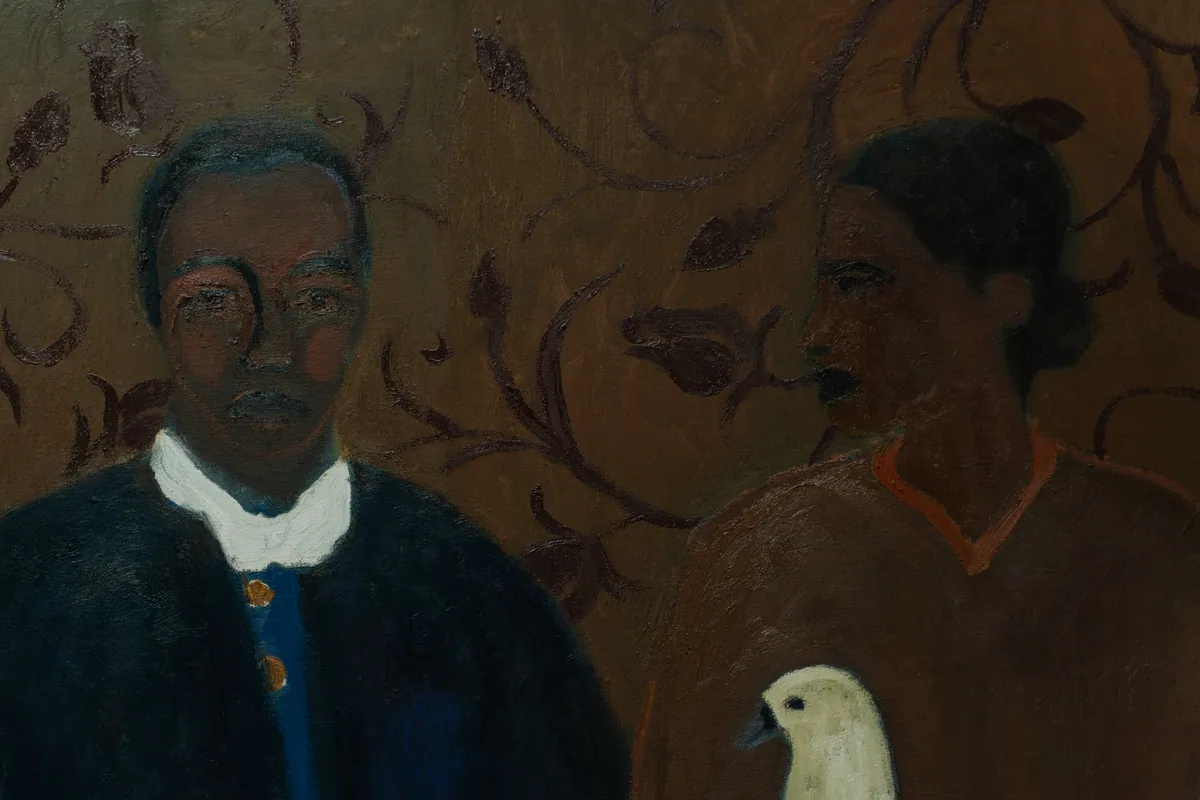
Two figures sit close on a bench against a wallpaper of trailing leaves, one in deep blue, one in burnt orange, with a white dove settled between them at the exact centre of the picture. Eugène is self-taught and works without sitters or reference photographs, and the result is a portrait of nobody in particular and therefore of a great many people: the posture is domestic, formal, and entirely composed. The dove is doing something specific. It is not symbolism dropped on top of the scene so much as the reason the two of them are holding so still.
Eugène moved from Brooklyn to Atlanta in 2019. Self-taught, he builds large-scale compositions around a central figure and works between abstraction and figuration, taking up Haitian and Haitian-American life, faith and family. In 2025 he was one of ten artists worldwide invited to reimagine the Lady Dior handbag for Dior Lady Art.
In the House
07
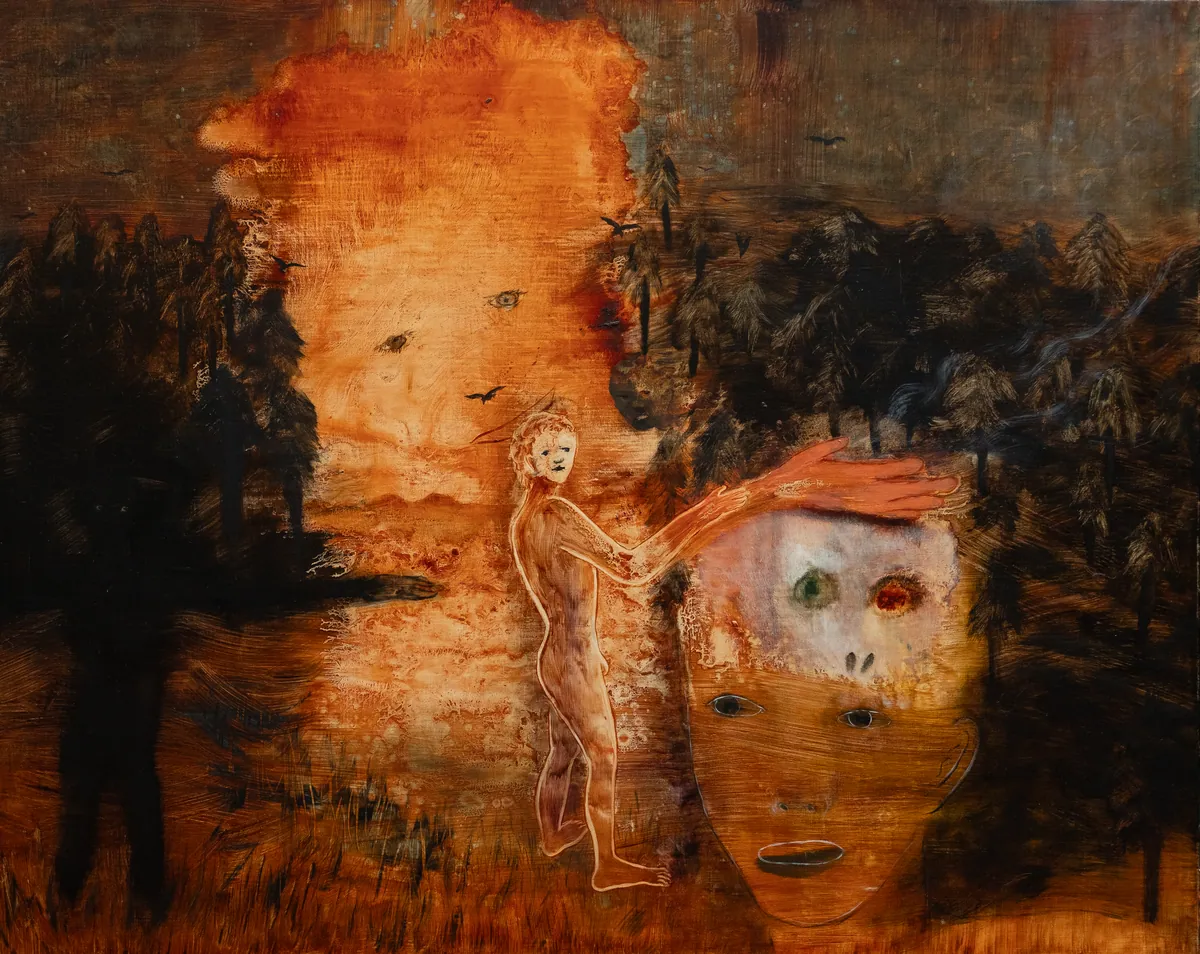
25.1.19
Asami Shoji
b. 1988, Fukushima, Japan. Based in Tokyo
- Year
- 2025
- Medium
- Oil on canvas over board
- Size
- Not recorded
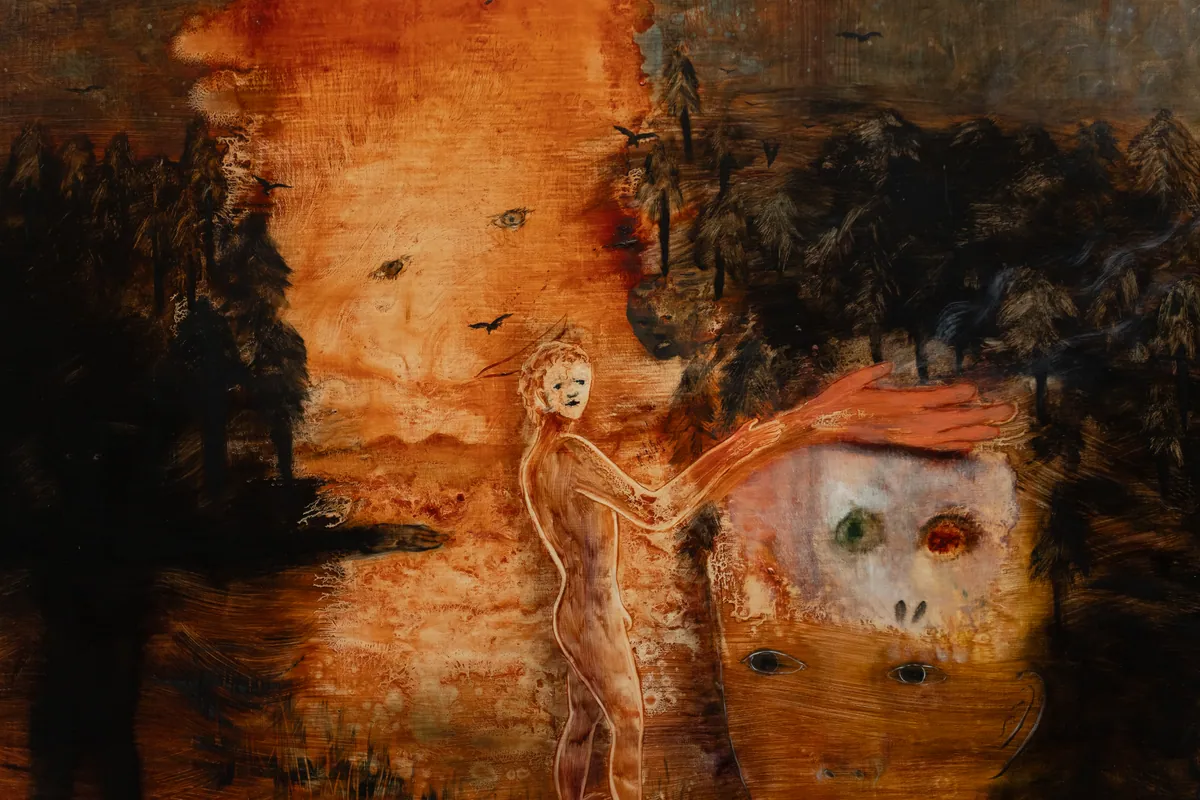
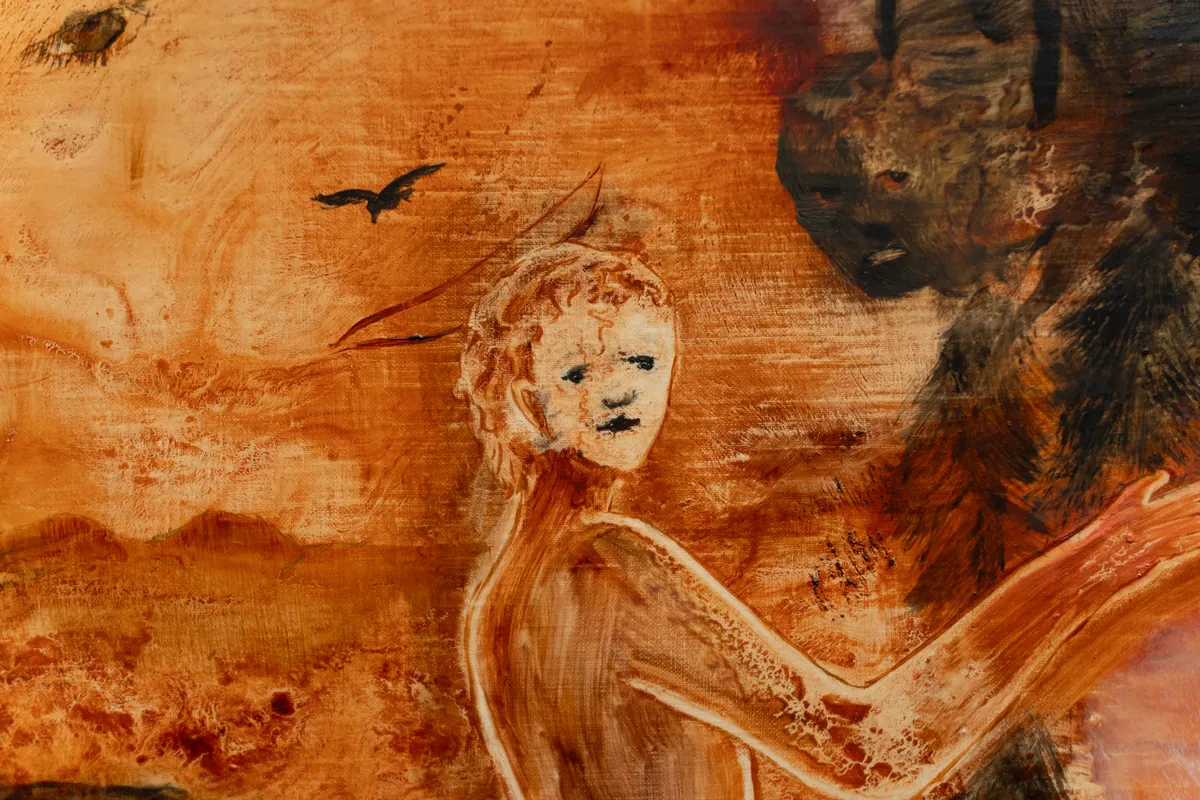
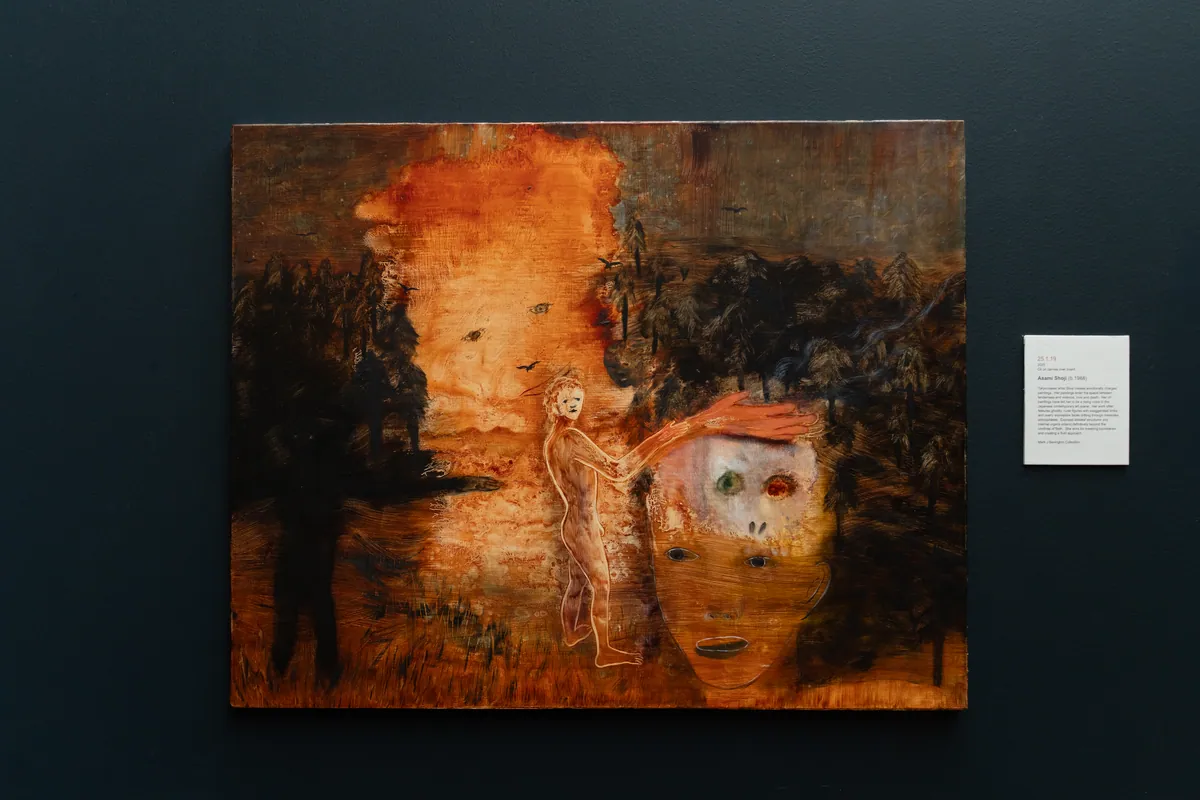
A burning orange ground, a treeline going black at the edges, and two presences that refuse to settle: a thin outlined figure walking forward, and an enormous face lying across the right of the canvas like something surfacing through the paint rather than sitting on it. Shoji builds figures out of haze, limbs stretched past proportion, expressions caught between tenderness and grimace, and this one is held exactly on the line she works: the sweetness of the small walking figure against the scale and blankness of the face beside it. The date-stamp title offers no help. It marks the picture as an entry rather than a statement.
Shoji took her MFA in printmaking at Tama Art University in 2012. Her paintings probe the liminal space between tenderness and violence, love and death, and she has said that the body is the beginning of painting. She won the Grand Prize at the FACE exhibition in 2019 and an Emerging Artist Award at the Gotoh Memorial Cultural Awards in 2020.
In the House
08
The End of Story
Amel Bashier
b. 1981, Jeddah. Sudanese, based in Paris
- Year
- 2025
- Medium
- Acrylic and ink on canvas
- Size
- Not recorded
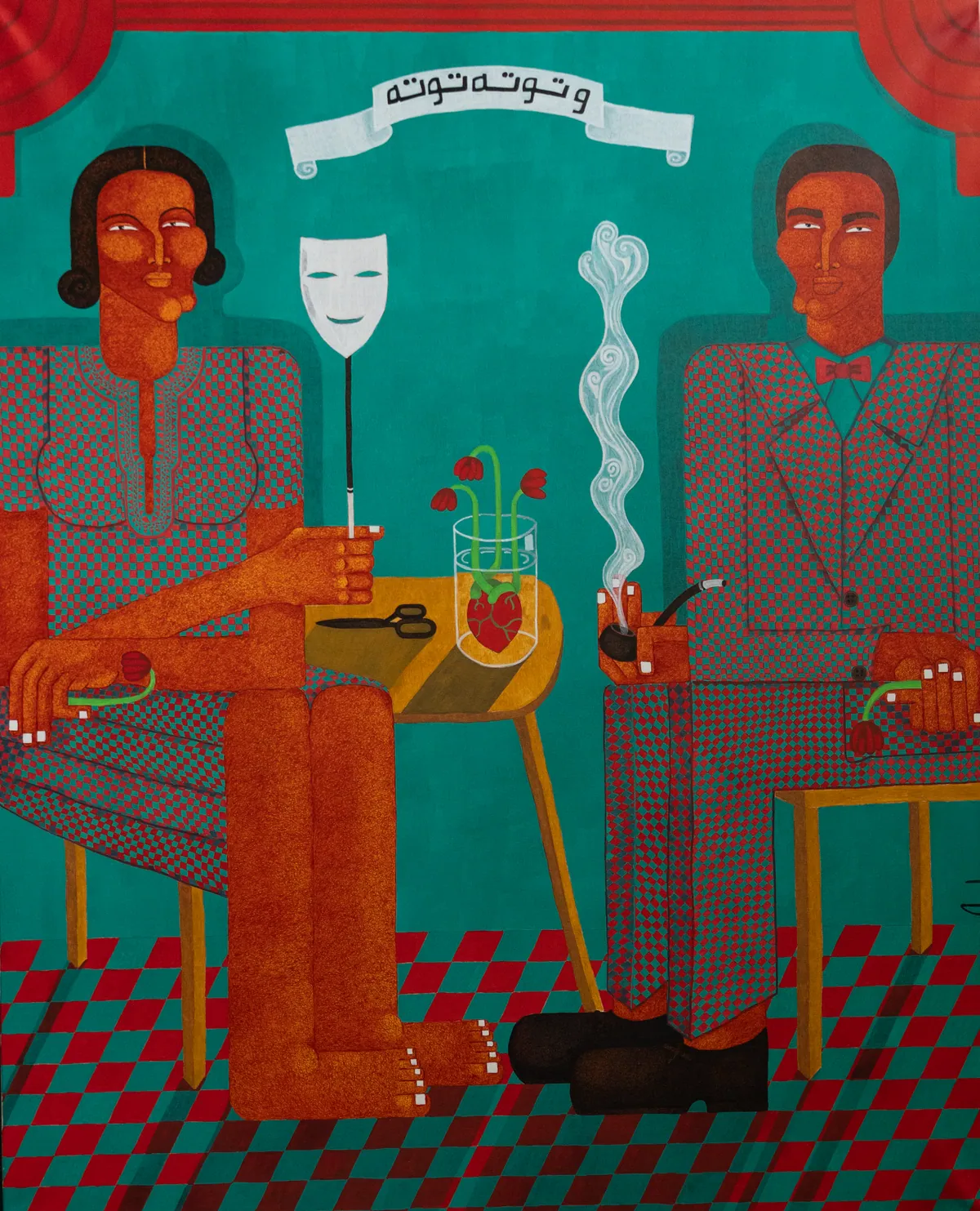
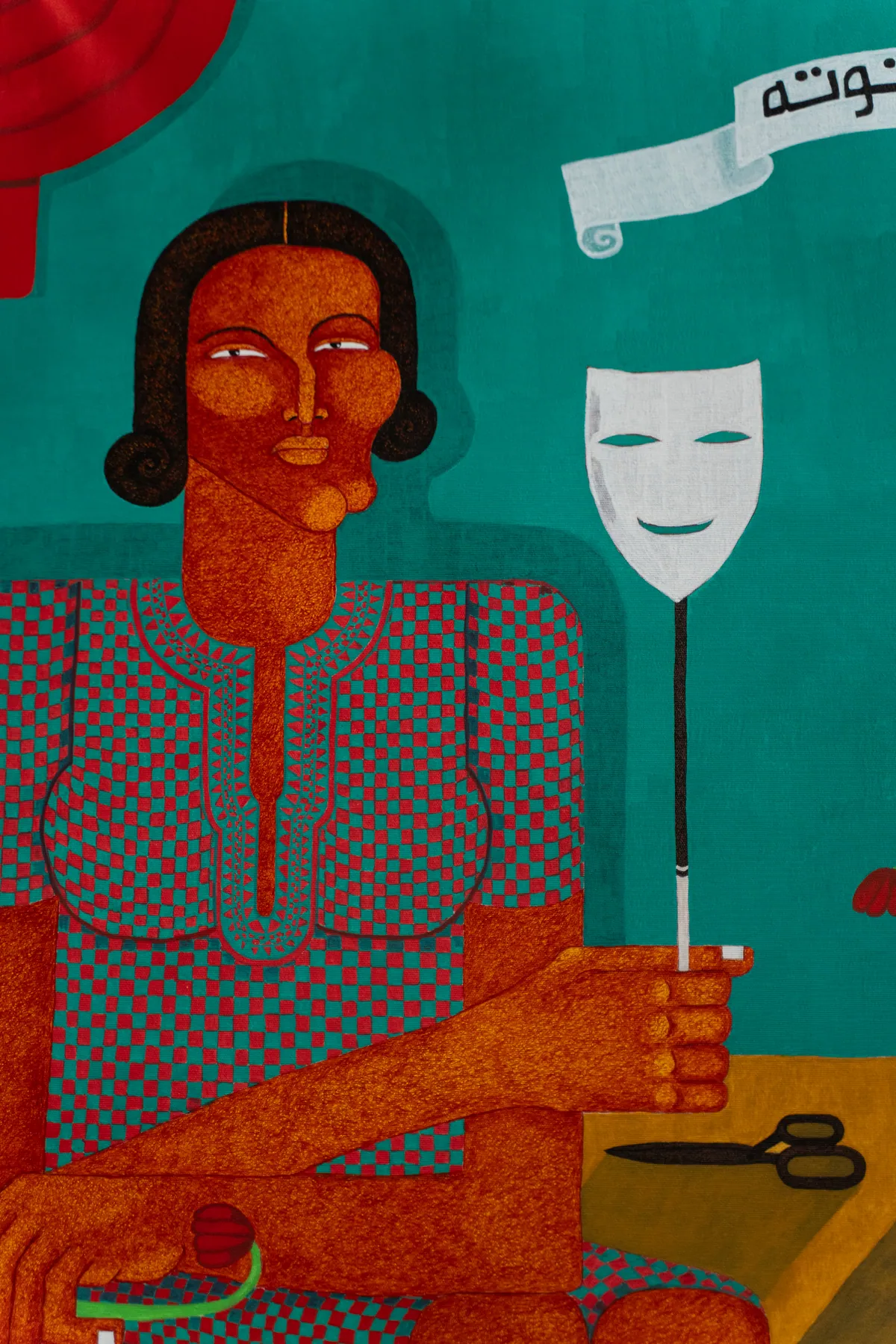
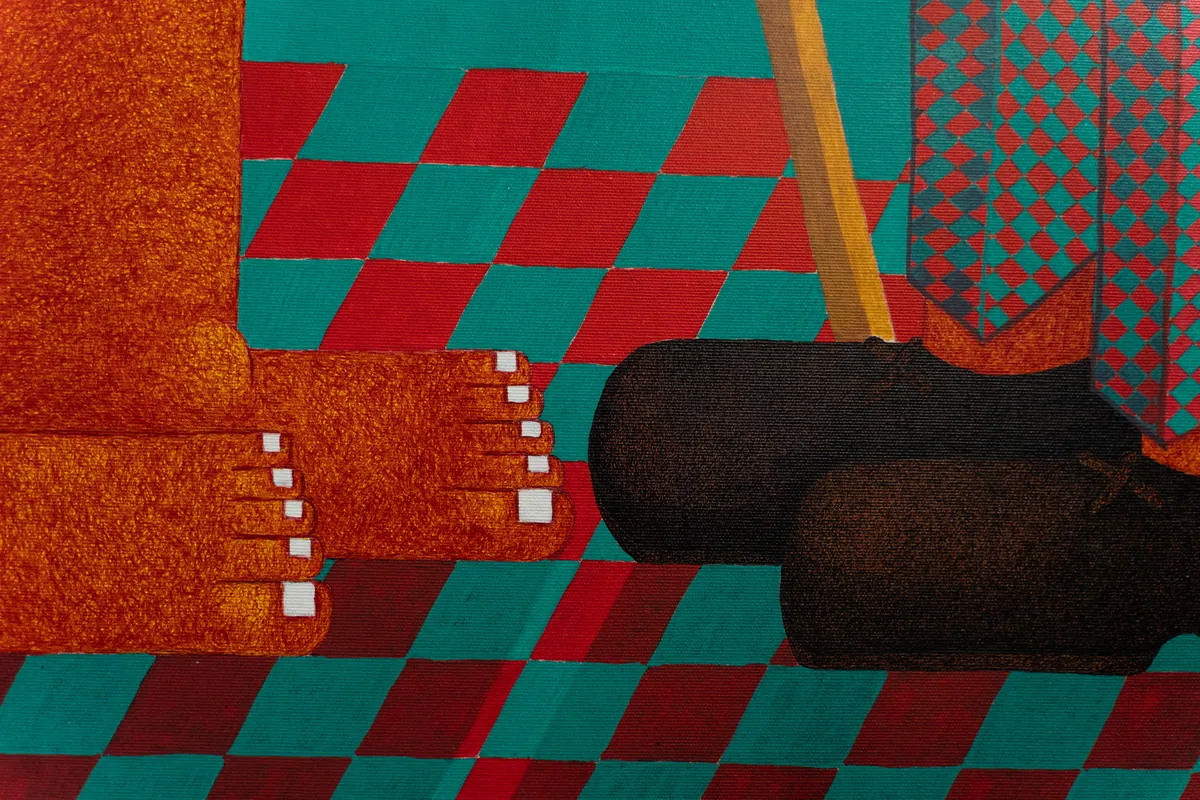
Two figures sit either side of a small table on a teal ground, a checkerboard floor running out beneath them, a banner of Arabic script unfurled overhead and a blank white mask hanging in the air between them. Bashier builds her surfaces from thousands of individual dots laid down with the nib of a pen, which is why the skin and the clothing hum at close range and go solid as you step back. The pair are symmetrical, composed, and not looking at each other. Whatever the story was, the title tells you where we have joined it.
Bashier spent her childhood between Jeddah and Port Sudan on the Red Sea and is now based in Paris. She works in intricate pen-and-ink and pointillist painting, drawing on Nubian history and the strength of her female ancestors, and has exhibited in London, Paris, Cairo, Dubai, Nairobi, Sharjah, Abu Dhabi and Khartoum.
09
Diana
Charlie Alston
b. 1997, San Francisco. Based in Paris
- Year
- 2021
- Medium
- Oil on canvas
- Size
- Not recorded
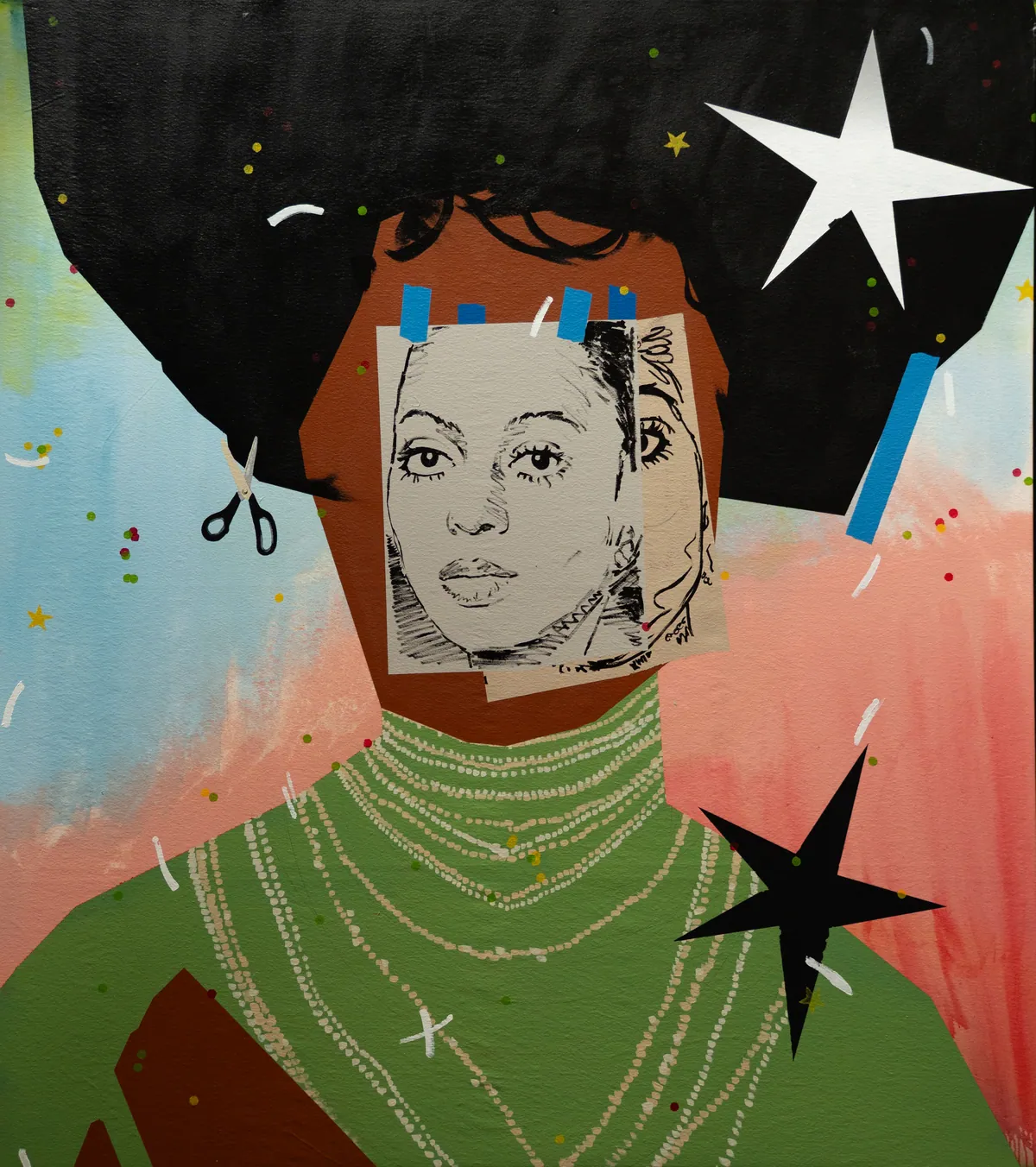
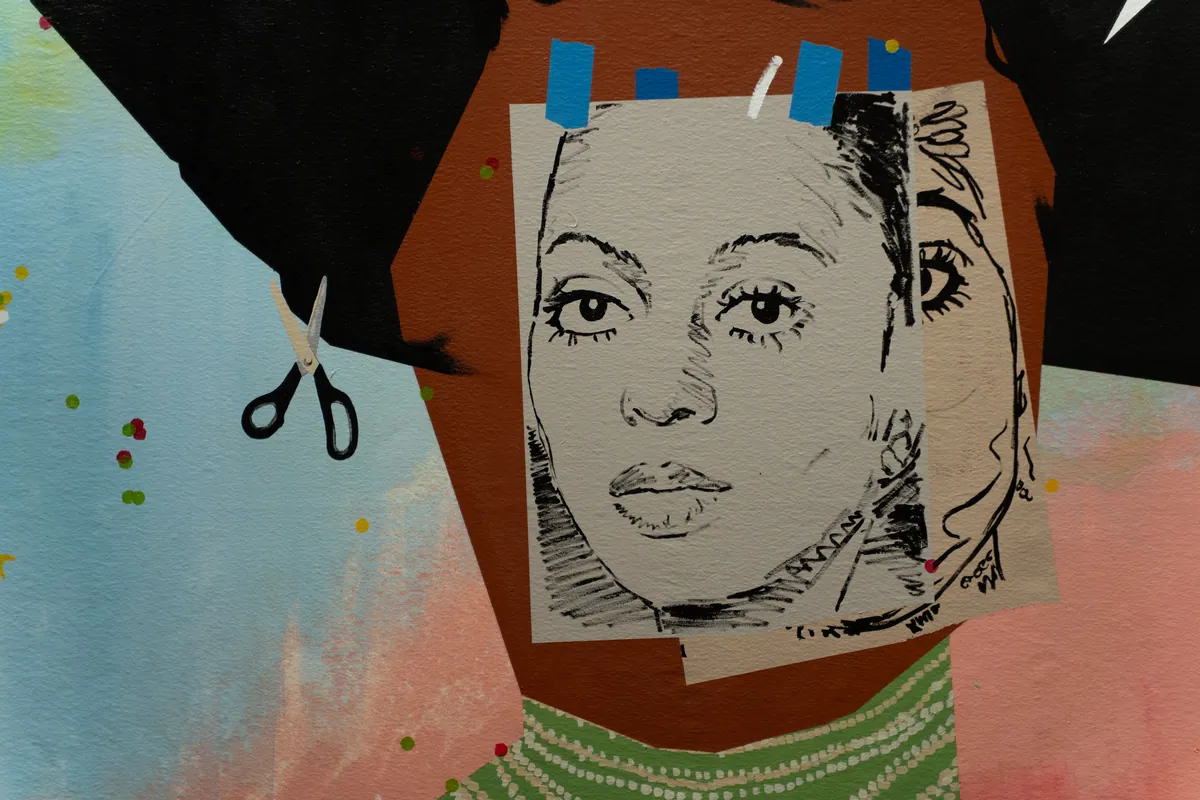
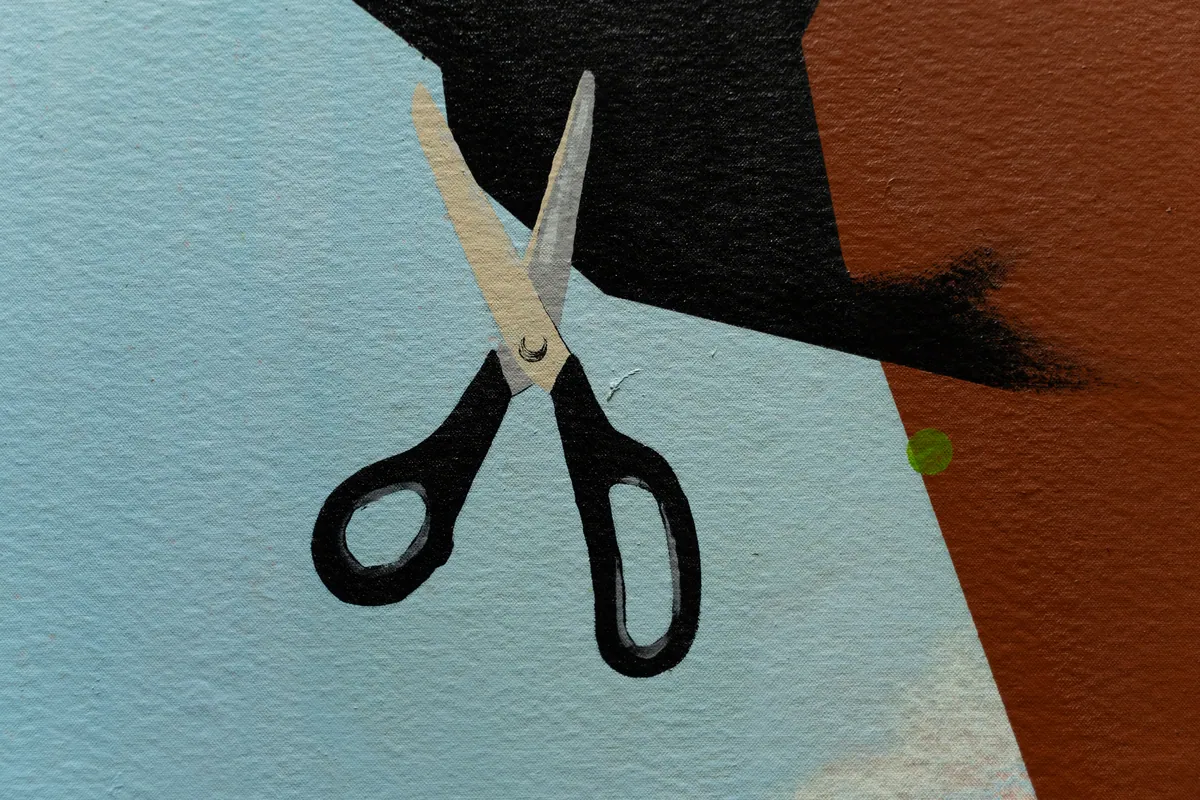
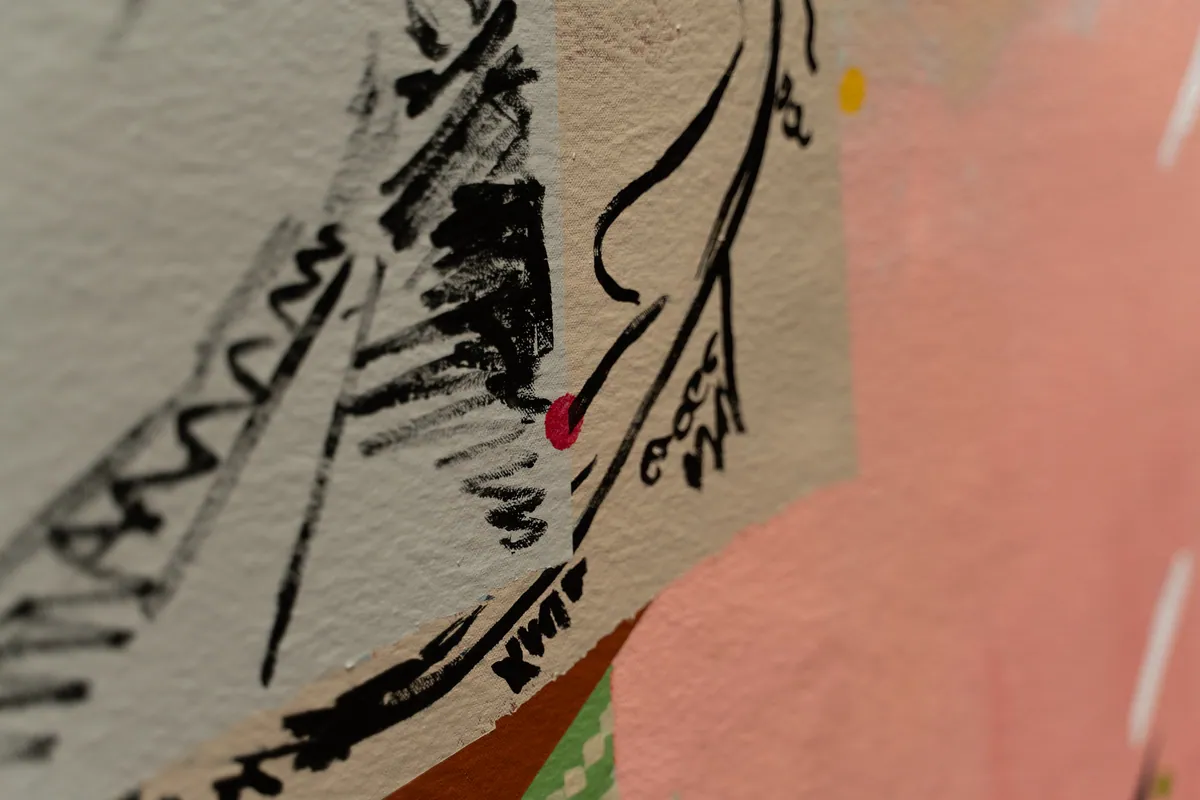
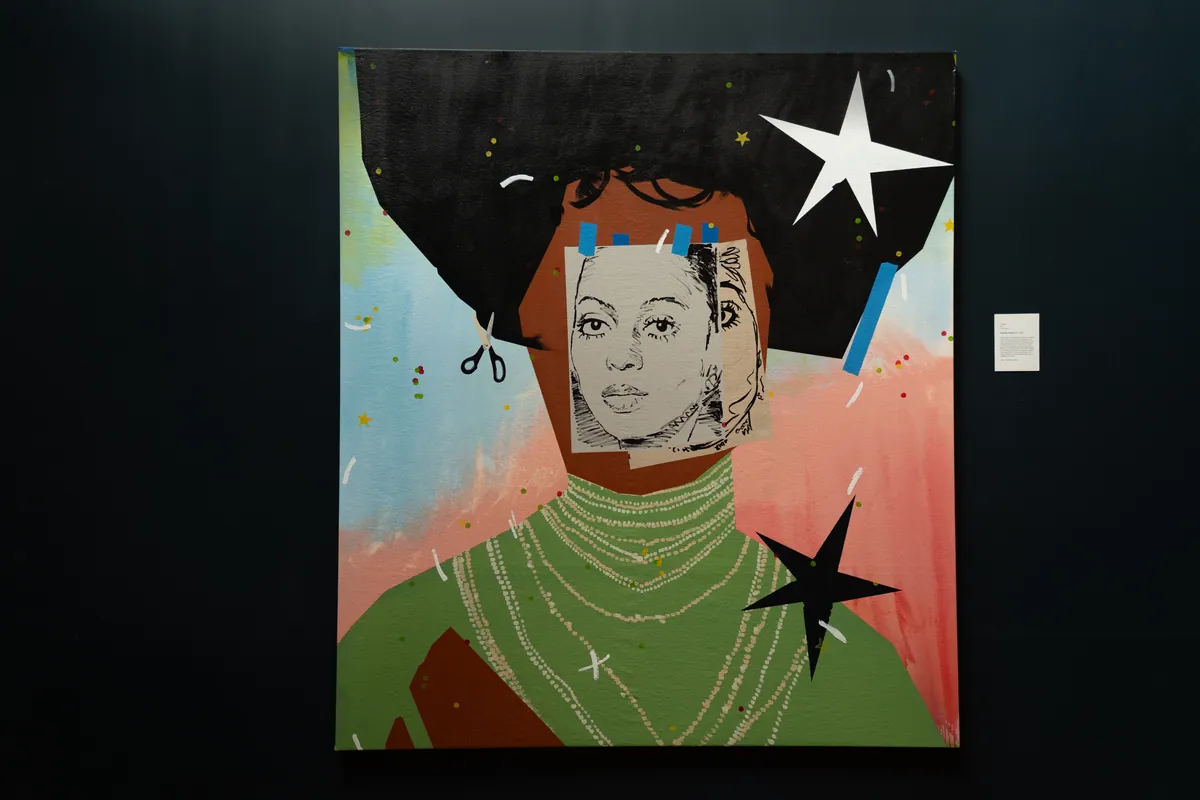
A woman in a green high-necked top against blue and coral, her hair a solid black mass crossed by a white star; where her face should be, a drawn face on a separate sheet of paper, taped over her own in strips of blue tape. Except none of it is stuck on. The label says oil on canvas and means it. The paper, the curling corner, the tape and its slight sheen are all painted, flat, one continuous surface. Alston takes his source material from post-war Black magazines like Jet, and the trick is the argument: an image that looks assembled from parts, cropped and re-taped by somebody else, turns out to have been made that way from the first mark. A pair of scissors floats at the shoulder in case you missed it.
Born in San Francisco, Alston took his BFA at the Pennsylvania Academy of the Fine Arts in 2019 and now lives and works in Paris. He paints pop-culture material from comics, branding and advertising into compositions that read as collage and prove, up close, to be flat. Figuration and abstraction melt into one seamless surface. He is represented by GNYP Gallery.
In the House
10
Heat Waves
Matt Bollinger
b. 1980. American painter and animator, based in New York
- Year
- 2024
- Medium
- Flashe and acrylic on canvas
- Size
- Not recorded
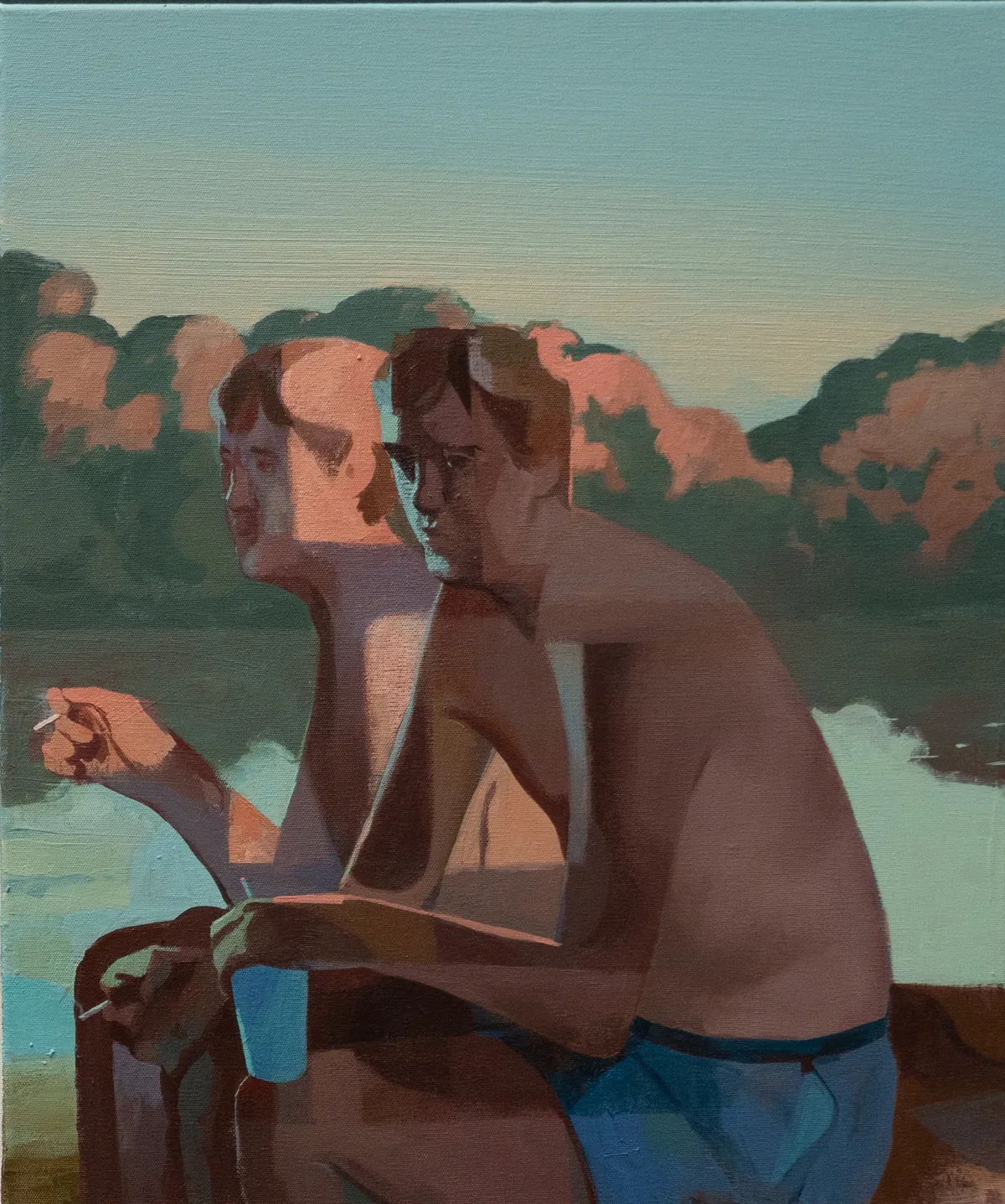
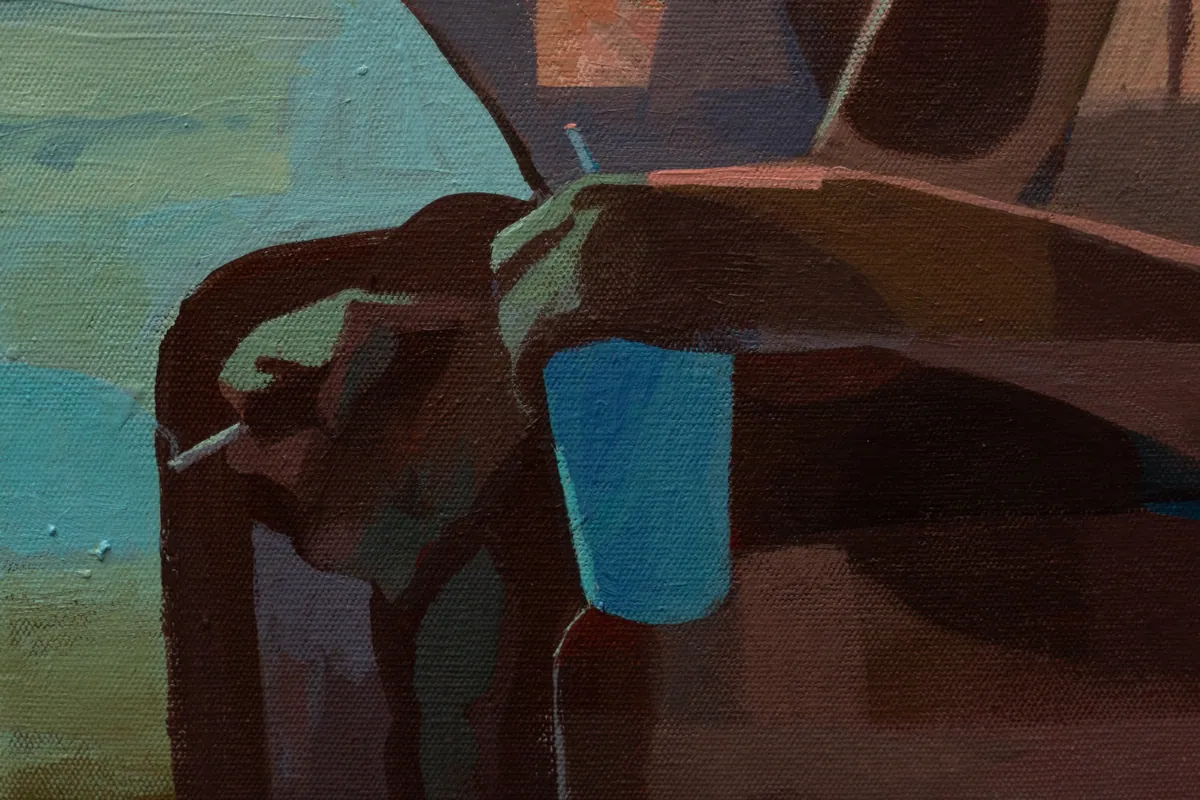
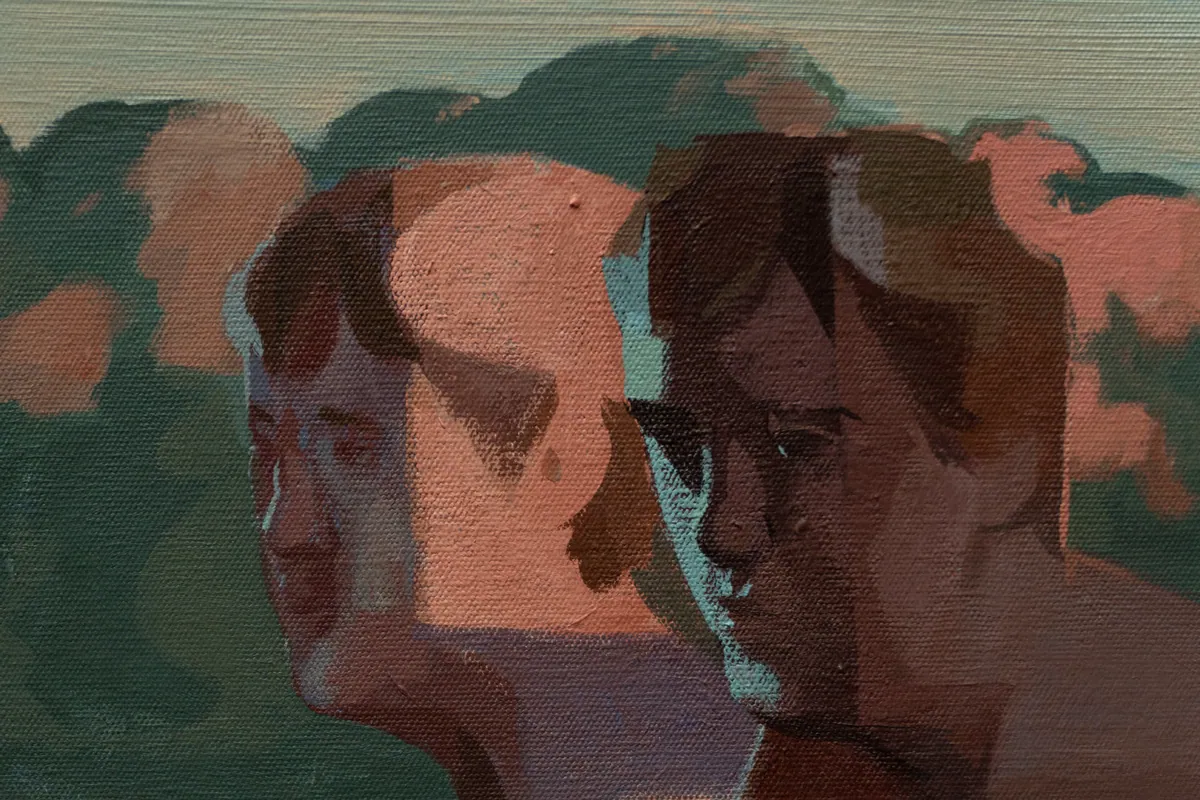
Two young men at the edge of a river at dusk, cigarettes going, a blue plastic cup on the arm of a chair. Both of them are doubled, their faces smeared sideways into a second position as though the painting caught two frames at once. Bollinger also makes stop-motion films by repainting a single canvas frame by frame, and that habit is visible here: the picture holds motion inside a still image rather than freezing it. The colour does the rest. Pink light on the treeline, cool green water, heat sitting on everything. It is a painting about a specific kind of American evening where nothing happens for hours.
Bollinger works largely from drawing, building paintings in Flashe and acrylic on canvas out of observation, art-historical reference and invented scenery. He is also an animator, painting his films frame by frame on canvas, and his subjects return repeatedly to the routines and unfulfilled hours of middle America. He rejects the word sad for the work and offers melancholy instead: sadness with contemplation included.
11
Laps of Chrysalis
Lila de Magalhães
b. 1986, Rio de Janeiro. Based in Los Angeles
- Year
- 2024
- Medium
- Dyed bed sheet (cotton), thread, chalk pastel
- Size
- Not recorded
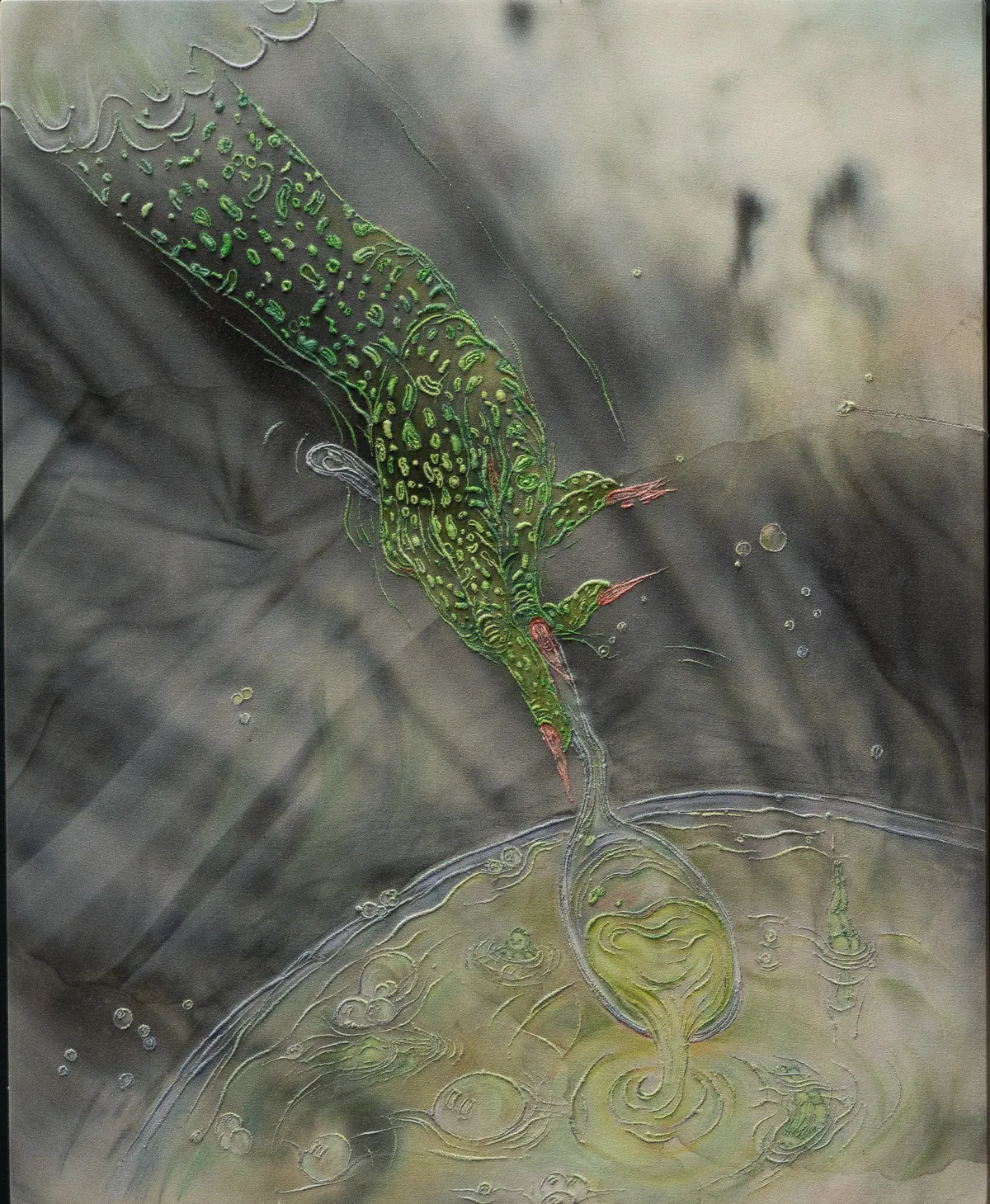
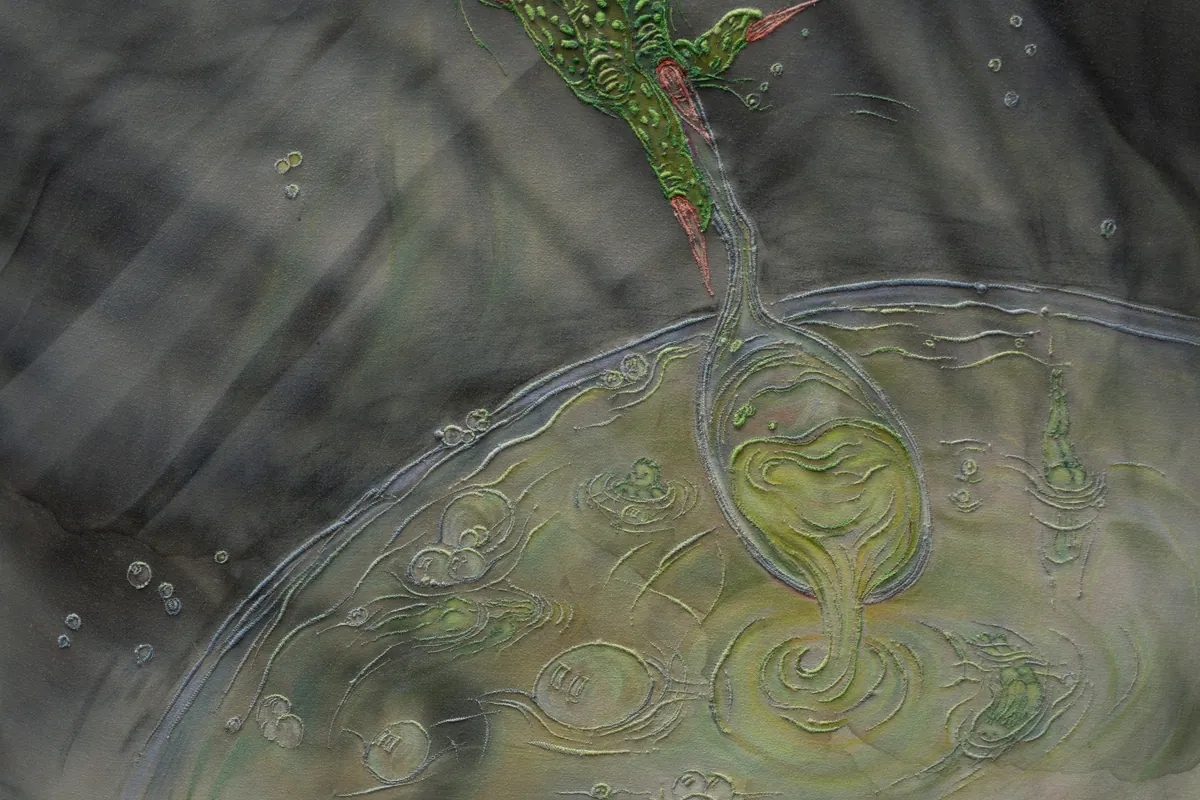
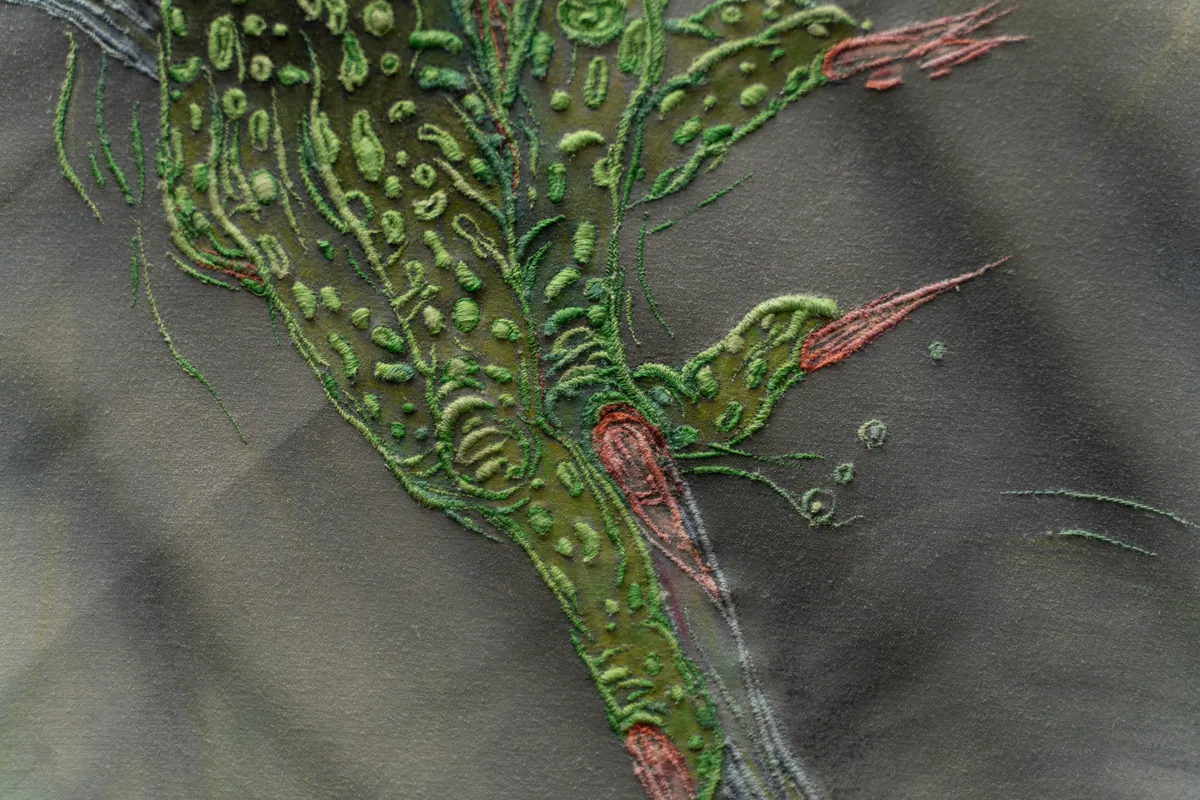
A long green creature, part lizard and part vine, bends down toward a pale pool where its own reflection curls back up to meet it. The support is a cotton bed sheet she has dyed, the soft haze of the ground is chalk pastel rubbed into the weave, and every contour of the animal is raised thread you could run a thumb across. Domestic cloth, in other words, doing the work of a canvas. De Magalhães writes in fable, and this is a creature from no particular myth: built from the unruly logic of the body, somewhere between animal, plant and person, and standing in for a desire rather than illustrating one. The title names a stage rather than a thing. Something here is mid-transformation and has not decided what it is becoming.
De Magalhães took a BA at Glasgow School of Art in 2008 and an MFA at the University of Southern California in 2013. Working primarily in textiles and ceramics, in soft whites and pale greens, she builds an intimate visual language out of fable, humour and the unruly logic of the body. The softness of the surface is not the character of the creatures on it: they are the revealers, exposing the fallacies of human society from outside it.
12
High Noon
Hadi Falapishi
b. 1987, Tehran. Based in New York
- Year
- 2024
- Medium
- Oil paint, cardboard, resin on wood panel
- Size
- Not recorded
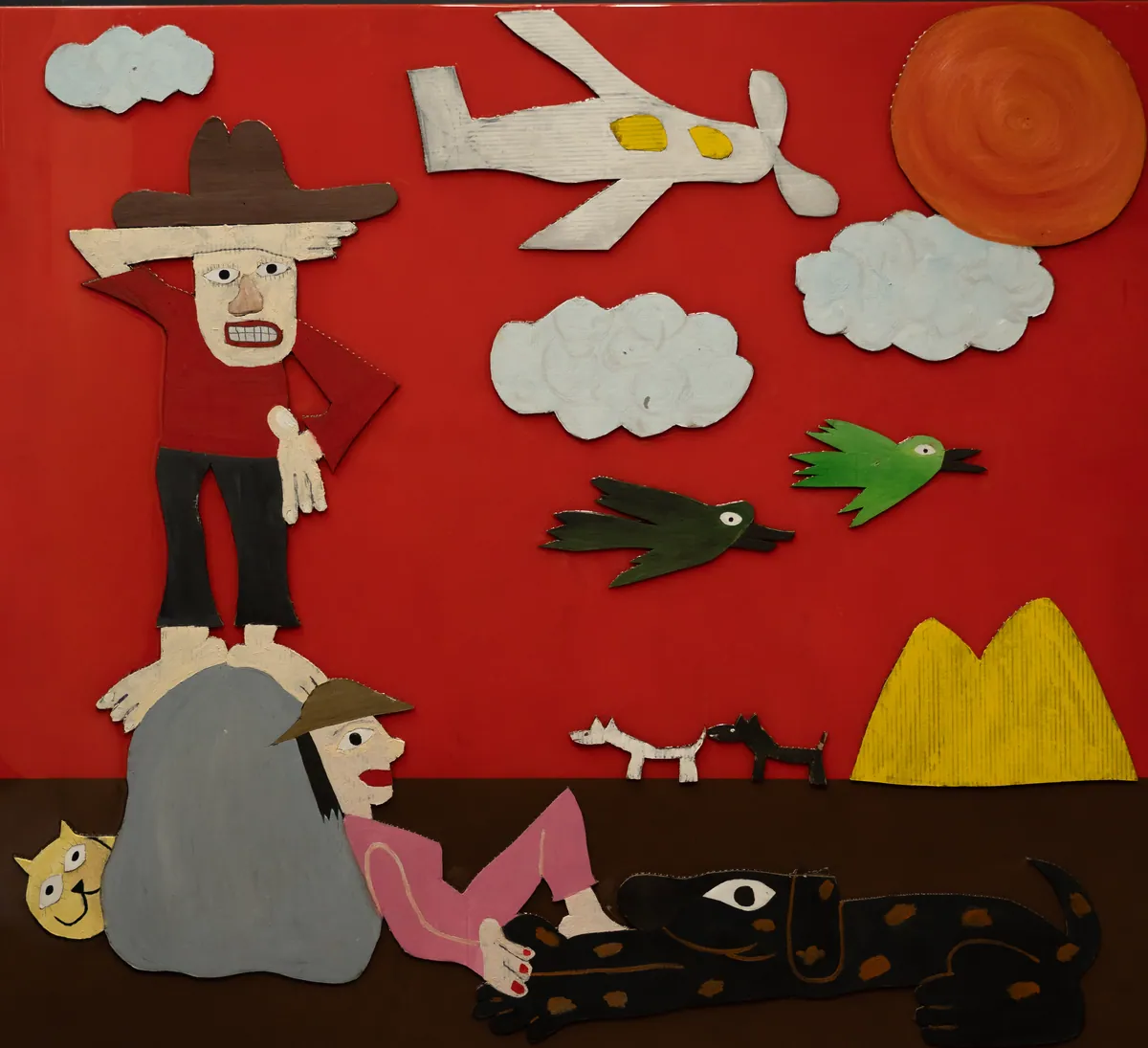
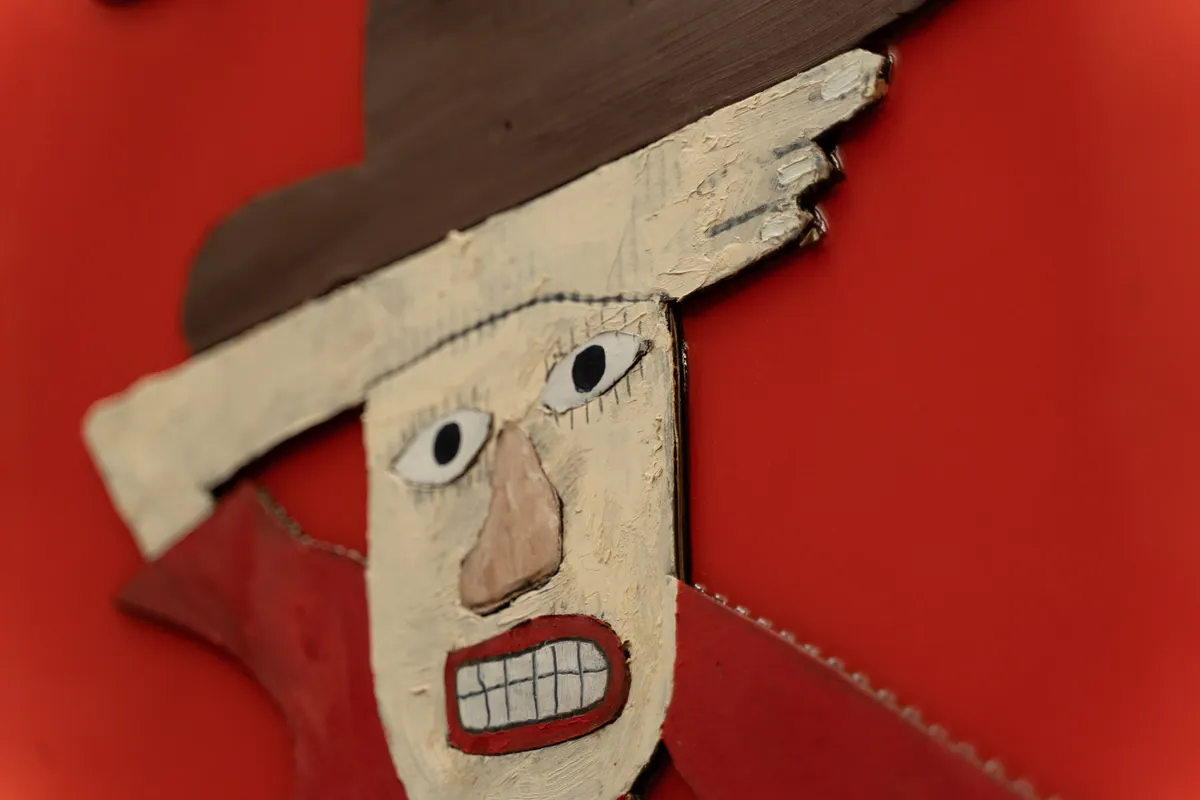
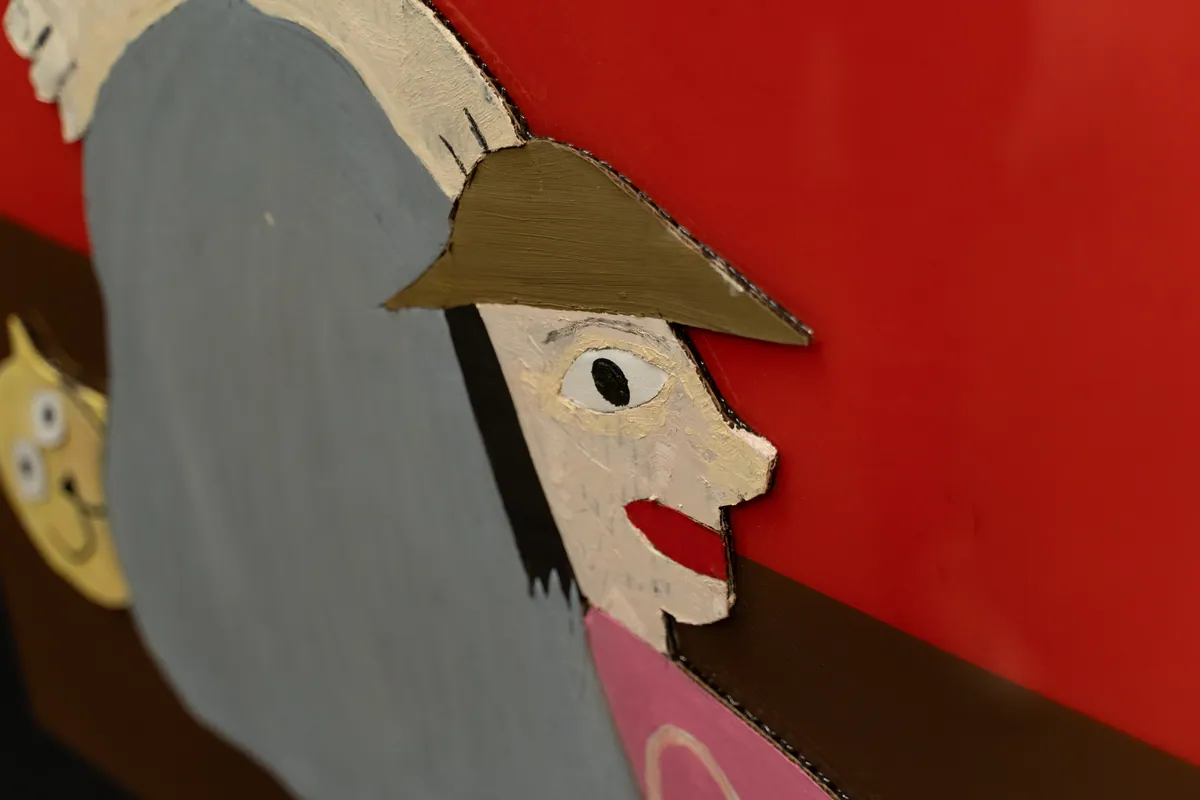
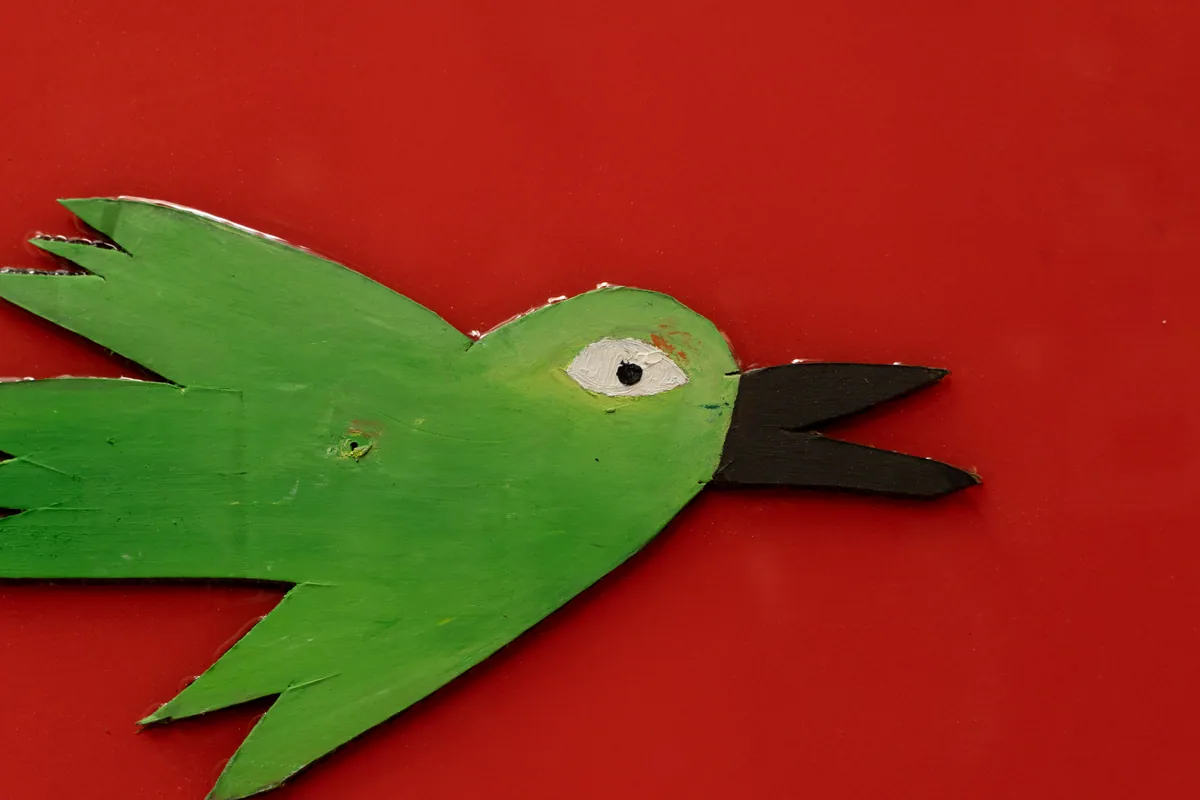
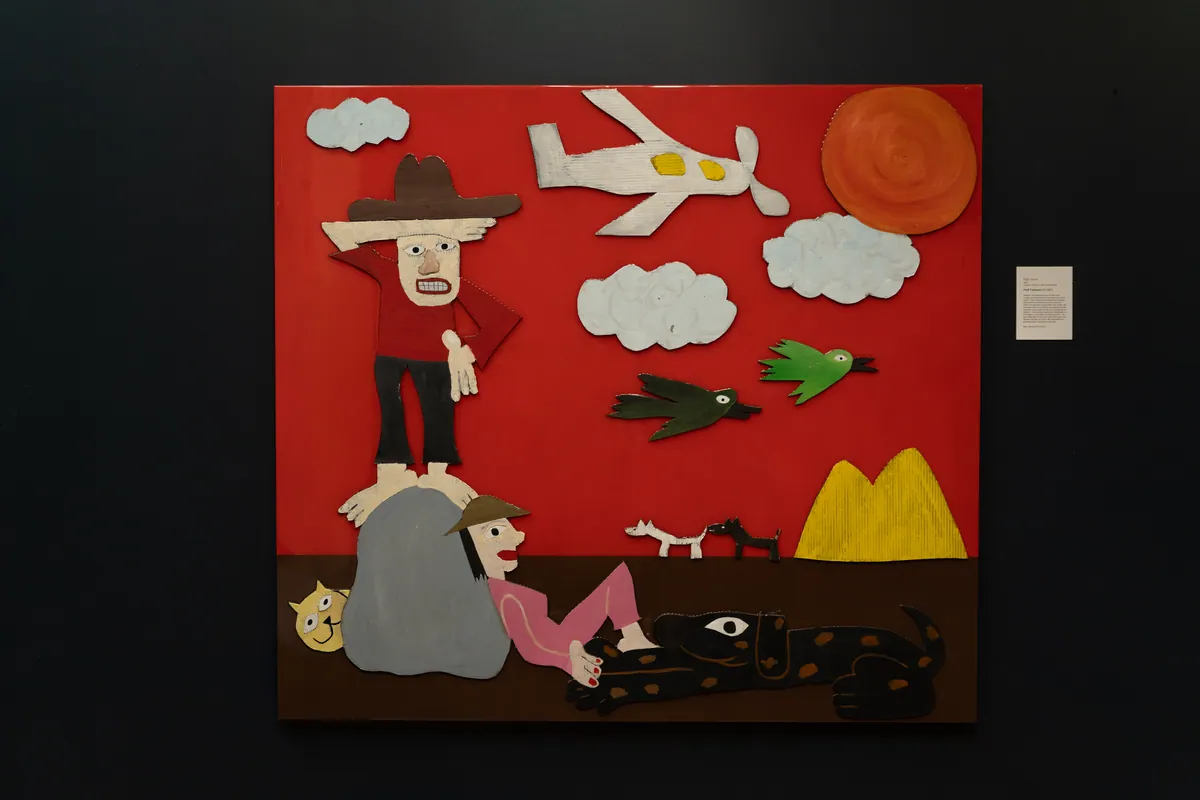
On a flat red ground: a cowboy standing with his arms up and his teeth bared, a plane, two clouds, two green birds, a pair of dogs, yellow mountains, and beneath him a reclining figure in pink with a cat. Every element is cut from cardboard, painted in oil and mounted proud of the wood panel, then the whole surface is poured in resin so it comes up glossy as a fairground sign. Packing material, sealed like a luxury object. That seam between handmade and store-bought, high and low, the artist and the clown is the ground Falapishi works. The cowboy, most overworked of American figures, ends up a cardboard cut-out with a panicked face. The comedy is the delivery system. What is actually on offer is a joke about who gets to play the hero, and how flimsy the set is behind him.
Falapishi received his MFA from Bard College in 2016. Spanning painting, drawing, sculpture and performance, he populates plainly recognisable settings such as houses, fences and open country with cats, mice, humans and other animals played for comedy. He uses them to show how tenuous those familiar structures are and how much isolation sits under them. His work is held in the permanent collection of the Whitney Museum of American Art.
In the House
13
The Ridiculous Ghost Heart
Gaia Fugazza
b. 1985, Milan. Based in London
- Year
- 2024
- Medium
- Traditional gesso, china ink, and mineral pigments in acrylic medium
- Size
- Not recorded
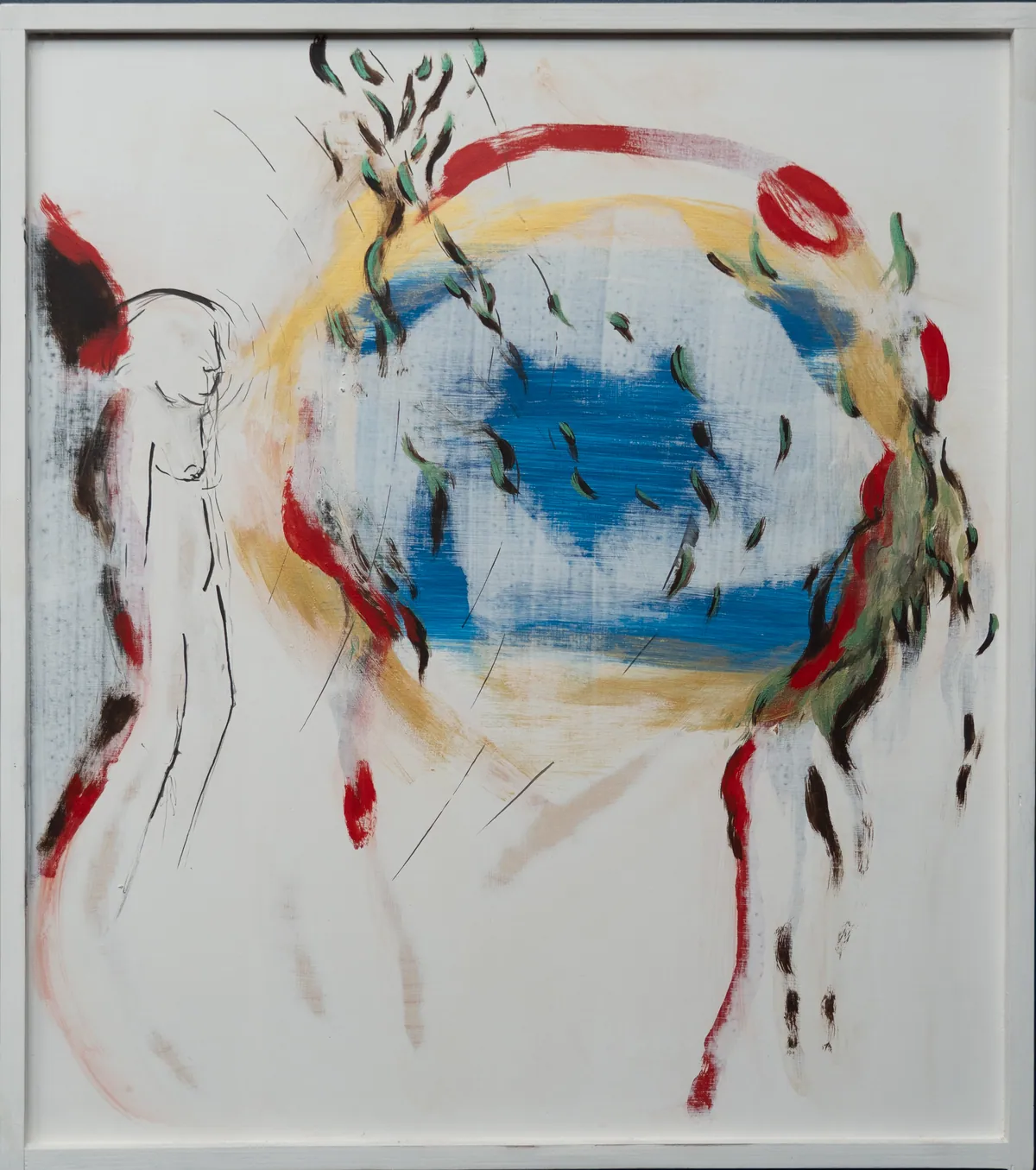
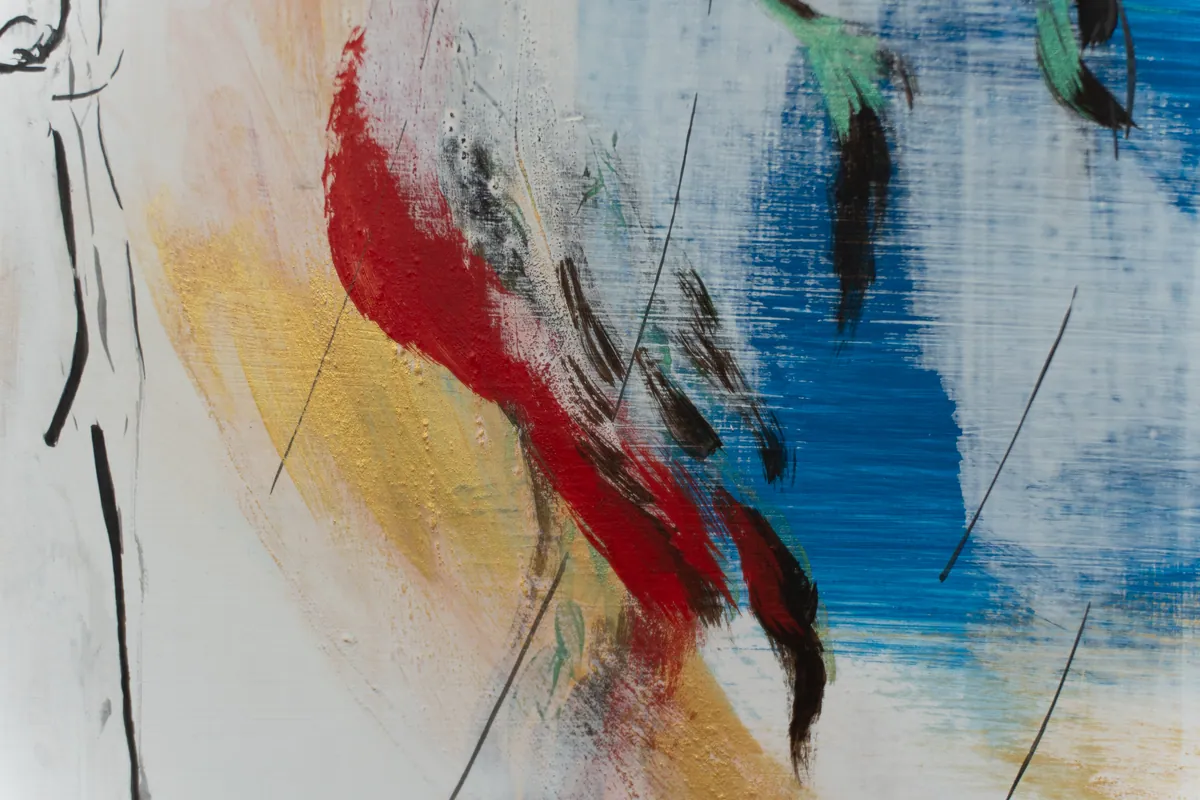
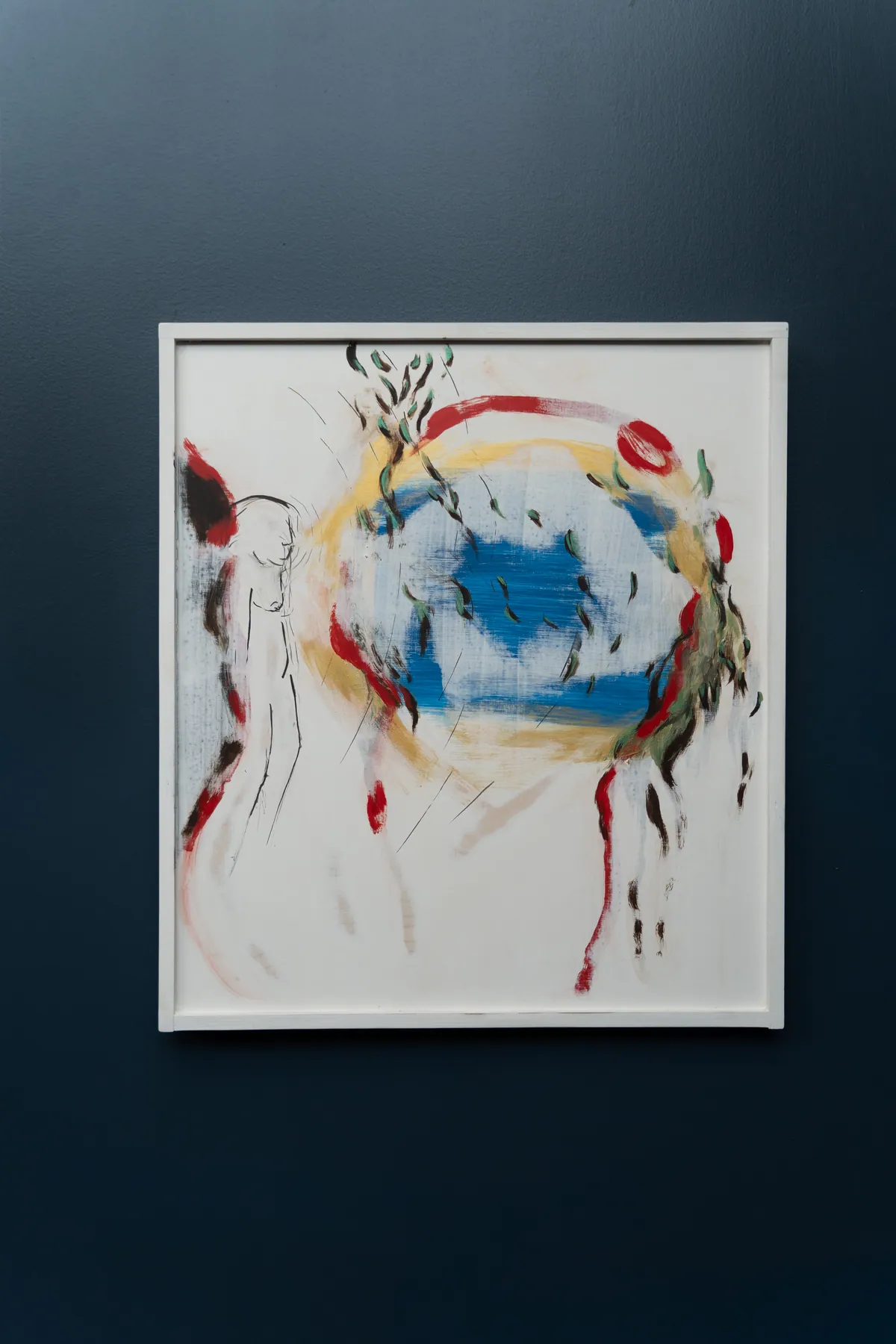
Against a white panel, a loose ring of yellow and red circles a soft blue centre, with thin lines resolving into two standing figures at the left and drips running down like the whole thing is still wet. The ground is traditional gesso, a mix of chalk and glue laid the way a panel was prepared six centuries ago. Everything on it is china ink and mineral pigment, which is why the marks look absorbed rather than glazed on and the drips read as stains. The mark-making is deliberately provisional, closer to something drawn on a cave wall than composed in a studio. Fugazza puts plants, animals and minerals on the same footing as people, and the organ named in the title is present mostly as a rhythm.
Fugazza completed an MA in Fine Art at Chelsea College of Arts in 2014. She works across carved, burned and waxed surfaces and self-made mineral paints, and her paintings and performances explore the troubled relationship between humans and the natural environment, plant knowledge, reproduction and transcendental practices. Hybrid anthropomorphic figures recur, and a primal mother among them, moving between the natural and technological worlds. She is represented by Richard Saltoun Gallery.
In the House
The Room
Hung together, they start a conversation
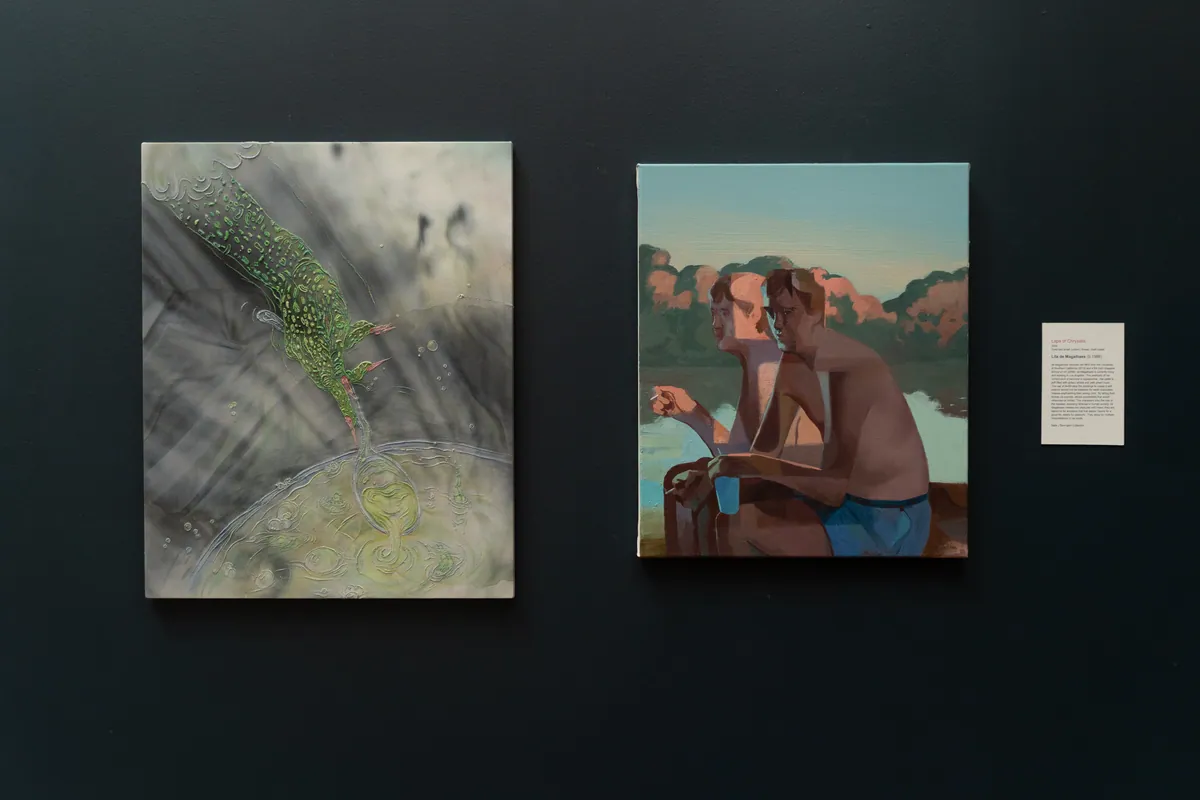
Lila de Magalhães and Matt Bollinger, side by side.
In Their Words
The collector and the curator, on the pieces they keep coming back to
On The End of Story
Mark Bevington on Amel Bashier
On Munzvimbo Yaunofamba Nekudzoka Wega I
Mark Bevington on Virginia Chihota
On Solitude
Mark Bevington on Emma Prempeh
On Fragmenting the Familiar
Paula Baldoni on Lane Cooper